
Have you noticed that many regions feature hybrid cable-overhead lines? Simply put, this refers to sections using overhead conductors alongside sections connected by power cables. As cities expand, suburban overhead lines are incorporated into urban areas, leading to widespread undergrounding projects. This creates numerous transitional hybrid lines—essentially a compromise driven by environmental constraints. This hybrid approach is particularly prevalent in the mountainous southwest and coastal southeast regions, where complex topography and typhoon resilience necessitate the combined use of cables and overhead lines. Furthermore, the current trend of integrating renewable energy sources—such as wind farms and solar power plants located in remote areas—has accelerated this trend. While these facilities use overhead lines for power collection, planning restrictions require switching to cables when connecting to the core grid. This transition inevitably fuels explosive growth in hybrid line installations.
In the field of power grid technology, this hybrid model has also driven the advancement of monitoring systems. This ensures that whether it's underground cables or overhead lines spanning mountain ranges, they can respond with lightning speed to sudden failures.
Dingxin Smart Technology's DX-WPS100-GZ02 AI-powered high-voltage cable fault early warning and location system integrates operational monitoring, fault prediction, fault localization, fault recording, fault alarms, and sampling communication. Unlike the "one-to-many" configuration where multiple sensor sampling units share a single distributed monitoring terminal, Our high-voltage cable fault warning and location system employs distributed monitoring terminals installed independently. These terminals collect phase-current waveforms and power-frequency fault current waveforms from phases A, B, and C. Each cable is equipped with its own dedicated monitoring terminal for separate sampling, enabling on-site digital processing of cable partial discharge signals. Following a fault occurrence, waveform analysis enables rapid identification of fault types. Online localization assists inspection personnel in receiving fault diagnosis and location information within 5 minutes.
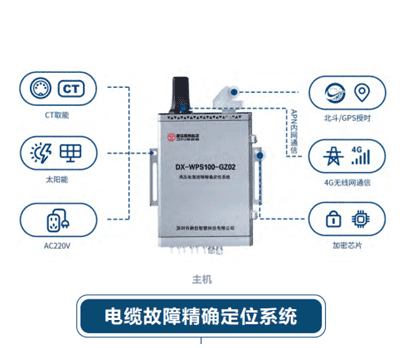
The device features multiple sampling ports. With dual timing from BeiDou and GPS, the system achieves wide-area synchronized clock accuracy below 100 nanoseconds, and overall cable fault location accuracy reaches ±5 meters.
Currently, our High-Voltage Cable Fault Early Warning and Location System has been installed on cable lines in multiple cities and regions, with users reporting excellent results. Installation employs an upgraded live-line installation method. Utilizing live-line working techniques, cable terminations can be connected or sensor devices added without power outages, minimizing the impact of construction on urban power supply reliability.

Cable-overhead hybrid lines represent the product of China's energy transition colliding with complex geographical terrain. However, the deployment of fault location equipment—such as high-voltage cable fault early warning and location systems—demonstrates that high-voltage cables are not helpless against sudden, unexpected failures! By precisely detecting minute anomalies at impedance discontinuity points, these systems can defuse crises before faults escalate. This addresses the persistent challenges of difficult fault identification and slow localization in hybrid lines, ensuring the stable transmission of green power!