
Cables—whether buried underground, run through conduits, or strung on towers—usually don’t make a peep. But when they do “make a peep,” it almost always means a circuit breaker has tripped, a cable has burned out, or a ground fault has occurred. Even more problematic are those multi-branch lines where overhead and underground cables run together—where exactly in the T-junction does the fault occur? Is it in the overhead section or the underground section? Relying solely on protection trip information makes it impossible to tell.
In reality, many incidents don’t happen suddenly at all. Overheating at joints, gradually rising sheath current, and partial discharges shifting from sporadic to continuous—these warning signs are always present. It’s just that, in the past, no one was monitoring them, and no equipment could keep an eye on so many points simultaneously. By the time the issue is actually detected, the defect has already escalated into a full-blown failure.
Dingxin Smart’s DX-WPS100-GZ02 Cable Fault Early Warning and Precise Location Device does just one thing—it transforms “waiting for it to fail” into “early warning before it fails.” Discharge spectra, pulse waveforms, loop current data, and joint temperatures are all monitored in real time online, with simultaneous alerts via backend pop-up windows and mobile text messages. If a fault does occur, traveling-wave technology at both ends monitors and locates the fault point, with an error margin reduced to within 0.1%L + 5 meters. No matter how long the line or how complex the branch topology, the system automatically narrows down the affected section for you, so you don’t have to start the testing process from scratch when you arrive on-site. A single unit can cover up to 10 kilometers. It features Beidou/GPS time synchronization and 4G/APN data transmission. Choose from three power supply options: inductive power, mains power, or solar power. With an IP66-rated enclosure, simply mount it in place—you won’t have to worry about wind or rain.
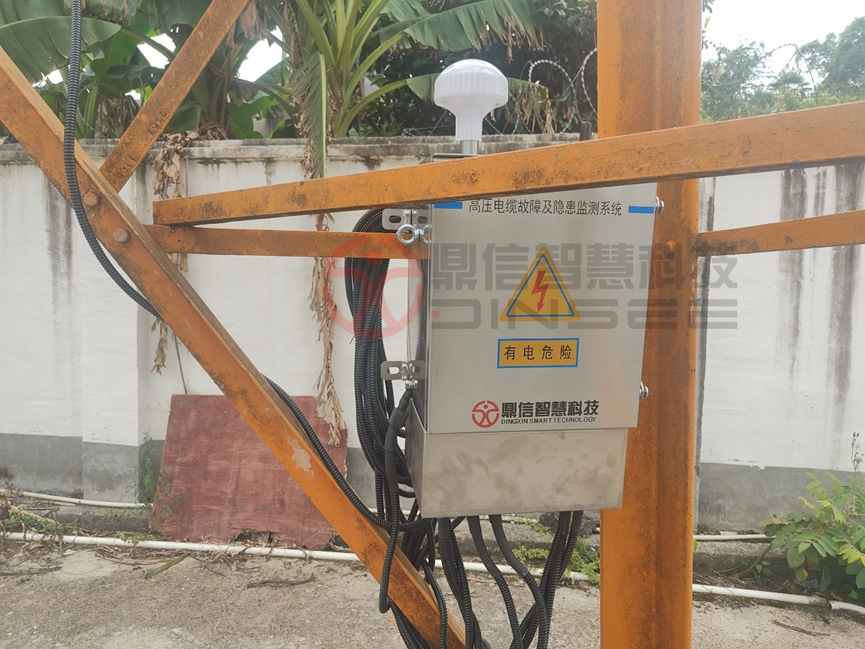
Simply put, it streamlines the previously tedious cable fault inspection process.
Rather than focusing on a single metric, the system provides comprehensive coverage of virtually all stages where cable faults can occur. While hard faults like short circuits, ground faults, and open circuits go without saying, the key is monitoring those stages where the cable hasn’t yet “completely failed”—such as when partial discharges gradually become more frequent, joint temperatures slowly rise, or sheath current quietly increases from tens of amperes to one or two hundred amperes. It monitors all of these. As soon as any parameter exceeds the preset threshold, the backend system immediately displays a pop-up alert, and simultaneously, an SMS notification is sent to the operations and maintenance personnel’s mobile phones—providing dual notification channels. Moreover, each alarm isn’t just a fleeting pop-up; the time, location, parameters, and waveforms are all archived. When it comes to conducting trend analysis, writing reports, or assigning responsibility later on, backend staff simply need to review the records.
Now, regarding data presentation. One of the most frustrating aspects of many monitoring devices is that they simply collect data and dump a bunch of curves onto the screen, leaving you to figure it out on your own. But the DX-WPS100-GZ02 Cable Fault Early Warning and Precise Location Device is different. It displays the discharge spectra, pulse waveforms, and frequency response curves for each monitoring point in real time and synchronized on the interface, eliminating the need for users to switch back and forth between screens. More importantly, it performs its own analysis—calculating metrics such as discharge peak values, discharge frequency ranges, and discharge current—and displays the results directly, while also automatically generating two-dimensional and three-dimensional phase spectra. Anyone familiar with partial discharge analysis knows that it’s sometimes difficult to determine the type of defect by looking at a PRPD spectrum alone. However, when overlaid with 2D and 3D phase spectra, it’s possible to identify with near certainty whether the discharge is a gap discharge, surface discharge, or floating-potential discharge.
Next comes location determination, which is the core value of the DX-WPS100-GZ02 Cable Fault Early Warning and Precise Location Device. When a fault actually occurs, it doesn’t just tell you “it’s roughly in this area” and leave everyone to guess; instead, it automatically runs a double-ended traveling-wave algorithm and directly outputs the fault distance, accurate to the nearest meter. The location error is controlled within 0.1%L plus 5 meters, where L is the total length of the cable section. You can do a rough calculation: for a one-kilometer cable, the error is only about six meters, so once you arrive on-site, you’ll basically avoid having to go back and forth. Temperature monitoring at joints is accurate to within 0.5°C, and the sheath current measurement range extends from 0 to 300 amps—this level of precision is more than sufficient for field use.
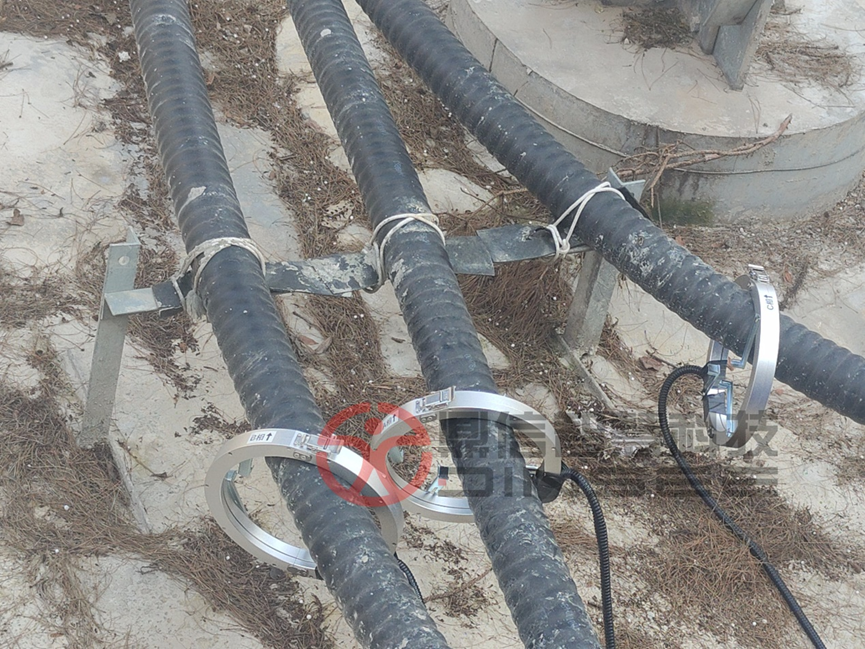
There’s another particularly practical consideration—cable lines aren’t simply laid out in a straight line from start to finish. Many actual cable lines have T-junctions with branches, with some sections running overhead and others underground. This raises a critical question: exactly which path of the T-junction is the cable fault located on? Is it in the overhead section? Or the underground section? In the past, determining this relied entirely on protection trip information combined with experience—often leading to incorrect assumptions and wasted trips. However, Dingxin Smart’s Cable Fault Early Warning and Precise Location Device can automatically isolate the affected section, telling you whether the fault is on the T-junction, in the overhead section, or in the cable section. This means that maintenance personnel know exactly where to go before they even leave the station, eliminating the need to split up and search the site once they arrive.
In addition to its primary function of discharge early warning, the Cable Fault Early Warning and Precise Location Device also incorporates line current monitoring and sheath circulating current monitoring. Many people don’t pay much attention to the sheath current parameter in their daily work, but persistently high sheath current often indicates damage to the outer sheath or a problem with the grounding method. If left unaddressed, this can lead to sheath burn-through and water ingress into the main insulation. The Cable Fault Early Warning and Precise Location Device’s expanded sheath current monitoring, with a range of 0 to 300 amps, covers all common operating conditions, eliminating the need to install a separate sheath current monitoring system.
We’ve also given careful consideration to on-site implementation. The Cable Fault Early Warning and Precise Location Device typically communicates via 4G or a dedicated APN network, eliminating the need to run fiber-optic cables on-site. For power supply, three options are available: inductive power harvesting, 220V AC mains power, or solar power—users can choose based on their site conditions without having to modify wiring specifically for power. The enclosure has an IP66 or higher protection rating, so there’s no need to worry about rain or dust when mounted outdoors. A single unit provides monitoring coverage of over 10 kilometers, with a minimum range of 5 kilometers—essentially, one unit is sufficient to cover the cable section between any two distribution rooms.
Finally, the software interface is entirely in Chinese, so you won’t have to guess your way through English menus. Joint status displays are organized into modular components; each joint is a separate module, with status colors, temperature readings, and alarm indicators clearly visible at a glance—no need to sift through a pile of tables. Additionally, the communication protocol includes an expansion interface. If the station-level monitoring platform has its own protocol requirements, data uploads and event confirmations can be integrated according to the platform’s format—it’s not a closed architecture that forces you to use “only our backend system.”
Looking at the big picture, I believe everyone now has a good understanding. The design philosophy behind the DX-WPS100-GZ02 Cable Fault Early Warning and Precise Location Device is actually quite straightforward—its features aren’t flashy, but each one is specifically designed to address the real challenges encountered in cable field operations.