
Tower structures and antennas form the backbone of communication networks. However, this backbone has never truly been “at rest”: repeated wind loads, thermal expansion and contraction caused by day-night temperature fluctuations, slow foundation settlement, subtle changes in the geological environment, and ongoing disturbances from surrounding construction activities… The combination of these multiple factors keeps the structure under constant dynamic stress.
Most people have a blind spot in their thinking: they assume that because a steel tower looks sturdy, there must be no problem.
In fact, long-term uneven tension and compression are slowly accumulating within the steel frame. These stress shifts, invisible to the naked eye, give rise day after day to hidden defects such as micro-deformations in the steel framework, gradual loosening of bolts, and fatigue cracks in structural members. When combined with extreme winds or heavy rain, these minor defects are instantly magnified, sharply increasing the risk of tower tilting, structural collapse, circuit tripping, and widespread power outages.
For a long time, high-risk stress areas in communication towers have primarily been concentrated in four locations: the main structural members of the tower legs, areas where the tower body changes cross-section, bolted joints, and the bases of crossarms. Furthermore, there are two unavoidable limitations: First, stress distribution is an internal mechanical property that cannot be directly determined through visual inspection; Second, extreme conditions such as typhoons, icing, and wildfires are precisely the times when structural responses are most severe, yet personnel cannot reach the site during these events. This means that critical data is missing precisely when it is needed most.
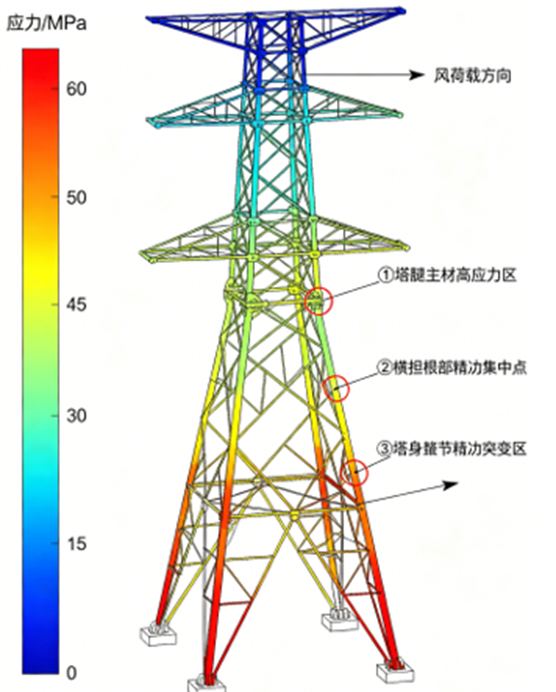
The solution lies in equipping the steel towers with “nerve endings”—real-time online stress monitoring.
Dinsee Smart Technology’s Online Stress Monitoring Device for Power Transmission Line Towers DX-WPS100-YL is the technological embodiment of this concept. Sensors are installed at critical points along the tower, automatically collecting various stress data in real time and uploading it to the monitoring terminal, where operations and maintenance personnel can view and analyze it remotely. When data exceeds preset thresholds, the system automatically triggers an alarm. Additionally, with built-in cloud-based analytics capabilities, the system enables automated stress monitoring and intelligent management of tower information, ensuring round-the-clock protection of structural safety.
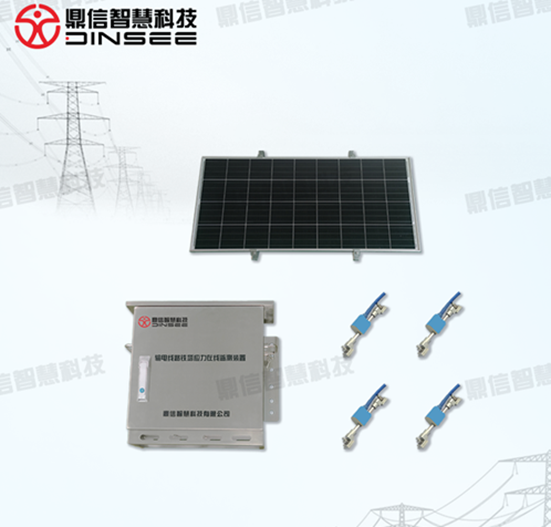
At the data acquisition level, the device supports both automatic and controlled acquisition modes. Users can flexibly set the acquisition interval based on the characteristics of parameter changes—with a minimum interval of 5 minutes and a default of 30 minutes—balancing real-time performance with storage efficiency. In addition, the device simultaneously monitors the communication signal strength at its location to ensure the monitorability of the data transmission link itself.
In terms of data storage and security, the device can store at least 90 consecutive days of monitoring data, which will not be lost even if communication with the master station is interrupted and data cannot be uploaded. In the event of a power outage, voltage fluctuations, or voltage sags, the recorded dynamic data remains fully intact; no manual deletion or modification is permitted, and external access cannot erase the data either—from hardware to software, multiple layers of defense are established to ensure data security.
In terms of early warning and communication, the device is capable of automatically triggering alarms for various types of anomalies, such as functional failures, communication interruptions, and data out-of-range conditions. Alarm thresholds are configurable, and alarm types can be distinguished between data anomalies and self-test anomalies. Alarm information is transmitted remotely in real time, and support policies can be flexibly modified, enabling precise and efficient O&M responses. Communication methods—including 4G/5G public networks, dedicated power industry wireless networks, or BeiDou short message services—are selected based on on-site conditions, and data transmission complies with the communication protocols of State Grid and China Southern Power Grid.
In terms of power supply reliability, the unit is equipped with an energy harvesting module, a battery, and an independent charge/discharge controller with a nominal voltage of 12 V DC. It features automatic float charging, overvoltage/undervoltage/overcurrent protection, and temperature compensation. Even under extreme conditions—such as prolonged lack of sunlight and no external power replenishment—the battery can sustain the unit’s normal operation for more than half a month, providing a reliable energy supply for remote sites without access to the power grid.
From “periodic tower inspections” to “automatic detection and remote data transmission,” a continuous online data stream transforms steel towers from silent giants into interactive, early-warning smart infrastructure, turning invisible stress changes into visible solutions.