I. Requirements Analysis
At major intersections, routine construction zones, and route corridors with unobstructed visibility, it is essential not only to monitor changes in the overall passageway but also to clearly observe machinery, personnel, and operational details in the distance. Wind direction, wind speed, and environmental changes can also influence the trajectory of floating objects, smoke, and construction-related risks. The standard model is suitable for key locations where risks persist over the long term and multi-directional patrols are required. By integrating close-up and distant views, the situation behind equipment, and on-site weather conditions, it enables on-duty personnel to make comprehensive assessments of alerts.
II. Operating Principle
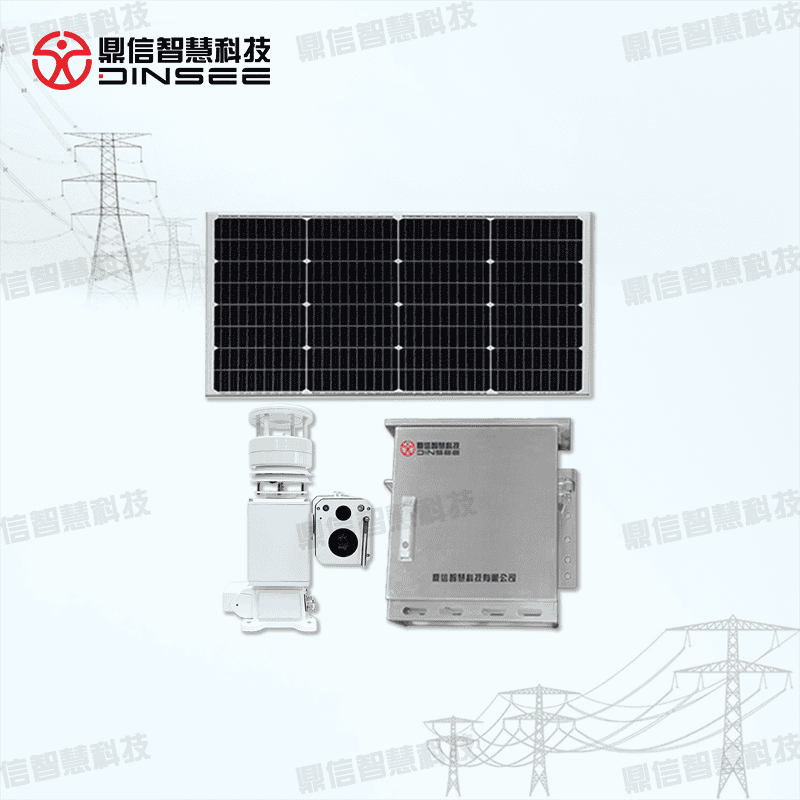
The wide-angle channel first provides an overview of the transmission line corridor, while the 40x zoom channel is responsible for verifying targets near distant machinery, work areas, or conductors; the rear-view camera supplements the view on the opposite side of the installation site. The PTZ camera captures images at preset positions, and edge detection algorithms filter out targets of interest and generate alerts; temperature, humidity, wind direction, and wind speed data are uploaded along with images from the same time period. When the network is unstable, images and alert data are first saved to local storage to prevent a single communication disruption from causing a loss of on-site records.
III. Features and Functions
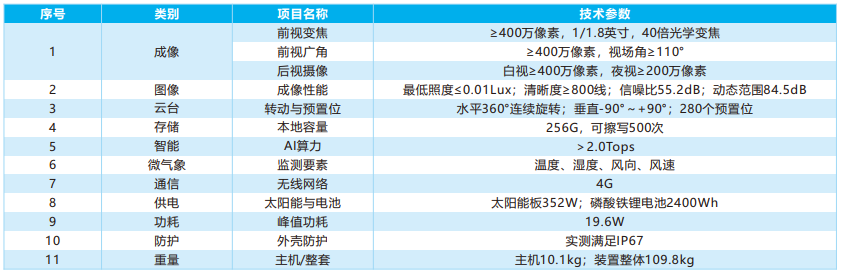
1. Excellent ability to distinguish distant details: front-facing zoom ≥ 4 million pixels, 1/1.8-inch sensor, 40x optical zoom;
2. Full-view coverage with rear-view blind spot compensation: Front-view wide-angle camera with ≥4 million pixels and a field of view of ≥110°; rear-view camera with ≥4 million pixels during the day and ≥2 million pixels at night;
3. Suitable for complex lighting conditions: minimum illuminance ≤ 0.01 lux, resolution ≥ 800 lines, dynamic range 84.5 dB;
4. Multi-directional automatic patrol: Continuous 360° horizontal rotation and -90° to +90° vertical rotation, with 280 preset positions;
5. On-site meteorological sensing of four parameters: Simultaneous monitoring of temperature, humidity, wind direction, and wind speed;
6. Front-end detection reduces unnecessary data transmission: AI computing power > 2.0 TOPS; structured alerts are triggered when anomalous targets are detected;
7. Centralized storage of inspection data: Equipped with 256 GB of local storage, capable of 500 erase/write cycles;
8. Stable communication via standard lines: Uses the 4G network to upload alarm images, videos, and device status;
9. Ample off-grid power capacity: 352W solar panel paired with a 2400Wh lithium iron phosphate battery; peak power consumption of 19.6W;
10. High-spec outdoor installation: The main unit weighs 10.1 kg, and the complete set weighs 109.8 kg; the enclosure has been tested and meets the IP67 rating.
IV. Product Specifications