I. Requirements Analysis
When construction machinery, trees, or floating debris appear near the ground wire, standard images allow the target to be seen but make it difficult to accurately determine whether the target has approached the safety boundary. Relying solely on manual visual inspection is prone to being influenced by shooting angles, perspective, and operator experience, which may lead to errors in distance estimation. The range-finding model is suitable for key sections where the risk of external breakage is concentrated, trees grow rapidly, and the conductors exhibit significant wind-induced sway. It transforms target detection into a clear-air distance assessment, providing a more direct basis for determining whether on-site intervention is necessary.
II. Operating Principle
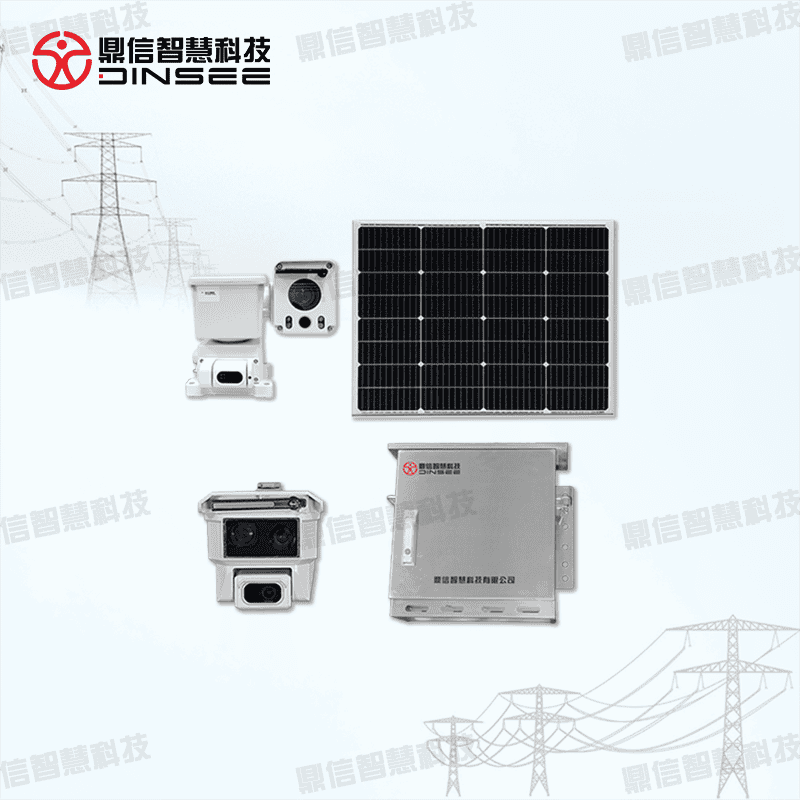
The main unit and auxiliary unit are installed at designated locations, and calibration of the camera’s internal and external parameters, mounting orientation, and baseline relationships is completed. The main unit is responsible for fixed-direction channel monitoring and rangefinding data collection, while the auxiliary unit adjusts its field of view using a pan-tilt head, wide-angle lens, and zoom lens. Range-finding cameras at both ends simultaneously capture images of the target and the guide wire. Through feature matching, geometric solution, and spatial reconstruction, the system calculates the clearance distance between potential hazards and the guide wire. Upon identifying a hazardous target or a distance exceeding the limit, the device generates an alarm notification and associated images, which are then uploaded to the platform for review and resolution by operations and maintenance personnel.
III. Features and Functions
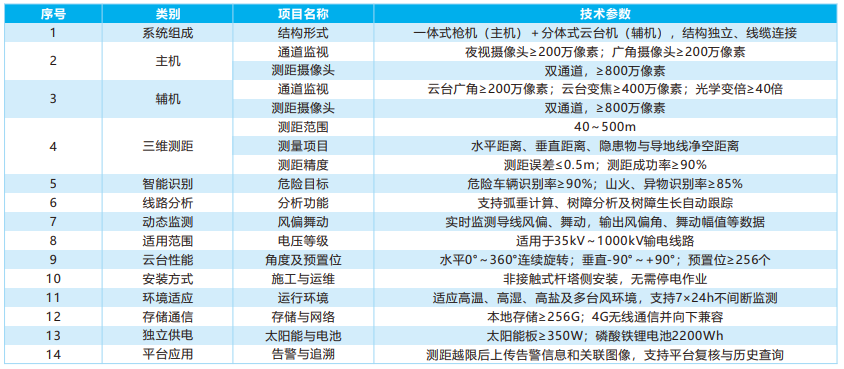
1. Coordinated measurement using a primary and auxiliary camera: The integrated gun-type primary camera remains stationary to monitor key directions, while the separate pan-tilt auxiliary camera handles directional scanning and detailed verification;
2. Dual-channel, high-resolution distance measurement: Both the main unit and the auxiliary unit are equipped with dual-channel distance measurement cameras, each with a resolution of ≥8 million pixels;
3. Balancing overall channel coverage and distant details: The primary camera’s night vision and wide-angle resolutions are both ≥2 million pixels; the auxiliary camera’s wide-angle resolution is ≥2 million pixels, its zoom resolution is ≥4 million pixels, and its optical zoom is ≥40x;
4. Direct quantification of 3D distance measurements: Measurement range of 40–500 m, error ≤ 0.5 m, and measurement success rate ≥ 90%;
5. Simultaneous output of multi-dimensional clearance distances: Calculates horizontal and vertical distances, as well as the clearance distances between potential hazards and the conductor and ground wires;
6. Accurate identification of hazardous targets: Hazardous vehicle identification rate ≥ 90%; wildfire and foreign object identification rate ≥ 85%;
7. More in-depth line condition analysis: Supports sag calculation, tree-obstruction analysis, tree-obstruction growth tracking, and conductor wind-induced deflection and flutter monitoring;
8. Comprehensive coverage of auxiliary equipment inspection range: continuous horizontal rotation from 0° to 360°, vertical rotation from -90° to +90°, with ≥256 preset positions;
9. Complete communication, storage, and power supply: Local storage ≥ 256 GB, 4G and backward compatible; solar panel ≥ 350 W, lithium iron phosphate battery 2,200 Wh;
10. Wide range of line compatibility: Suitable for 35 kV to 1,000 kV; features non-contact installation on the side of transmission towers; requires no power outage; supports 24/7 operation.
IV. Product Specifications