I. Requirements Analysis
When poor contact or abnormal heat dissipation occurs in tension clamps, splice points, or related hardware, the initial signs often manifest only as localized temperature rises, which are difficult to detect visually. Manual temperature measurements are influenced by inspection intervals, weather conditions, viewing angles, and distance; they can only reflect the status at the time of inspection and make it difficult to determine whether temperatures are rising continuously. Temperature-monitoring devices are suitable for critical connection points and high-load sections. By continuously monitoring the locations of hot spots and temperature changes, they provide a basis for the early detection of abnormal heating, trend verification, and maintenance scheduling.
II. Operating Principle
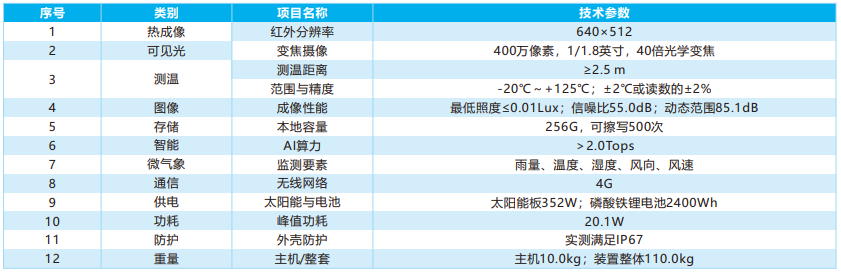
A visible-light zoom lens is used to verify the phase, hardware locations, and appearance, while the 640×512 infrared channel captures the temperature distribution of the same target. The device performs timed temperature measurements at preset positions and supports point, box, and area tracking, as well as tracking of the hottest spot; when temperature thresholds are met, it simultaneously saves the thermal image, visible-light image, and measurement values. The platform compares historical trends with temperature, humidity, wind direction, wind speed, and rainfall, and supports comparisons between similar devices and across different time periods, providing continuous evidence for verifying abnormal heat generation.
III. Features and Functions
1. Clear details of the infrared temperature field: With a thermal imaging resolution of 640×512, it can display the temperature difference distribution across hardware components and connection points;
2. Temperature measurement range suitable for line applications: Measurement range -20°C to +125°C, with an accuracy of ±2°C or ±2% of the reading;
3. Long-range visible-light-assisted positioning: 4-megapixel, 1/1.8-inch sensor, 40x optical zoom;
4. Verification of thermal image-to-visual image correspondence: minimum illuminance ≤ 0.01 lux, signal-to-noise ratio 55.0 dB, dynamic range 85.1 dB;
5. Flexible configuration of multiple temperature measurement methods: Supports highest-temperature-point tracking, point-by-point temperature measurement, selected-area temperature measurement, and zone temperature measurement;
6. Meteorological-Assisted Judgment Based on Five Factors: Simultaneous collection of rainfall, temperature, humidity, wind direction, and wind speed;
7. Continuous Temperature Trend Archiving: Equipped with 256 GB of storage, it can retain thermal images, visible-light images, curves, and alarm data;
8. Simultaneous edge detection: AI computing power > 2.0 TOPS, supporting both temperature monitoring alerts and target detection in the passage;
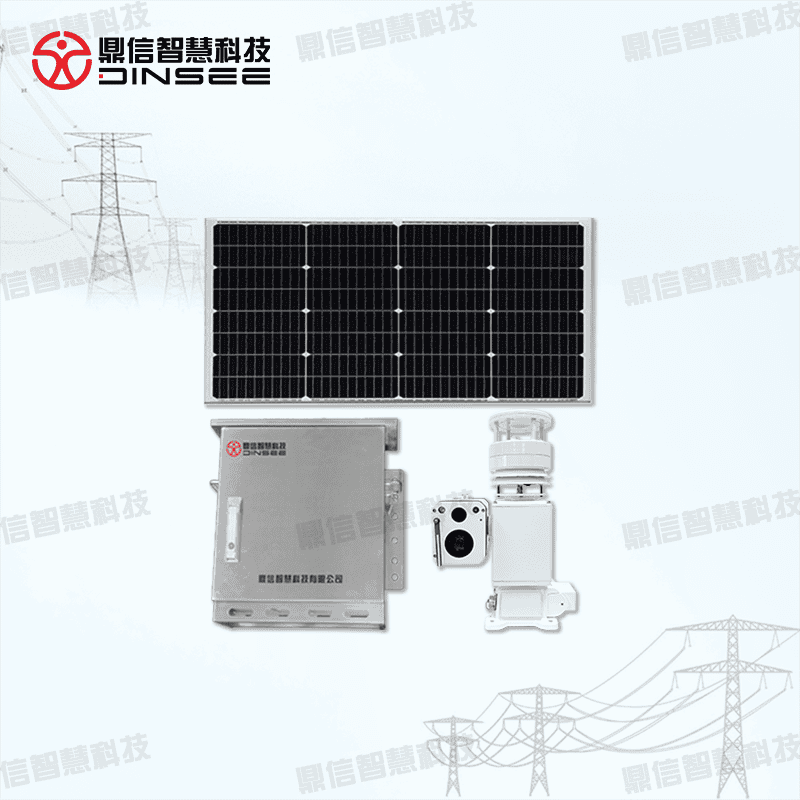
9. High-Capacity Standalone Power Supply: 352W solar panel paired with a 2400Wh lithium iron phosphate battery; peak power consumption of 20.1W;
10. Long-term deployment on key towers: 4G communication; main unit weighs 10.0 kg, and the complete set weighs 110.0 kg; the housing has been tested and meets the IP67 standard.
IV. Product Specifications