I. Requirements Analysis
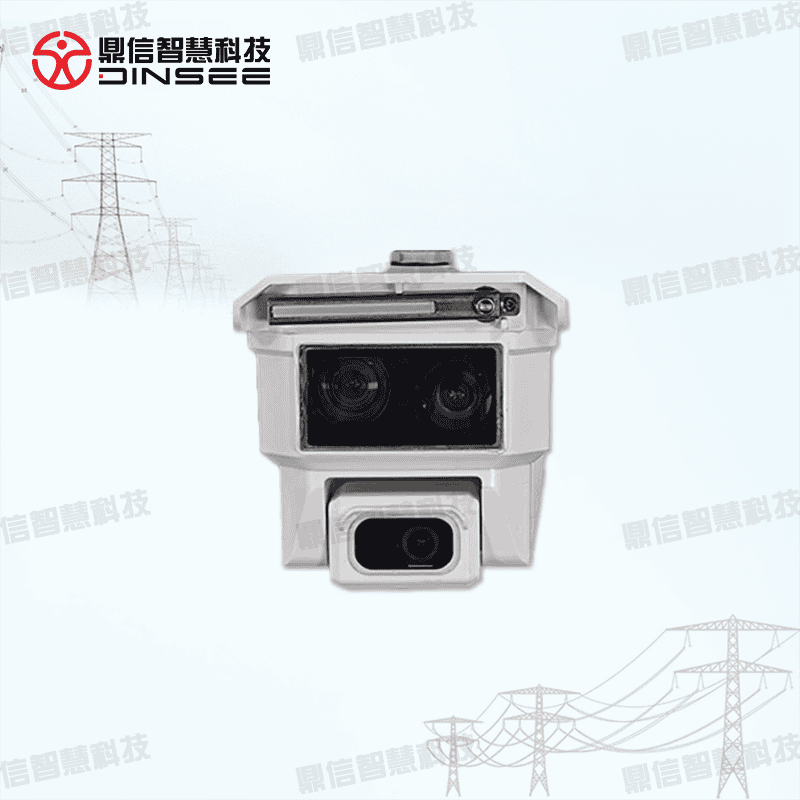
In straight tunnels, at shaft entrances, and directly in front of equipment, the viewing direction is relatively fixed; on-site monitoring focuses more on the depth of the passageway, personnel operations, the presence of foreign objects, and whether the video feed is continuous and reliable. Light levels inside tunnels are low, and there are significant variations in brightness; standard camera equipment often struggles to capture distant objects clearly or is affected by direct light sources. Tunnel fixed-view cameras maintain a fixed field of view, making them suitable for long-term monitoring in a single direction and facilitating comparisons of passageway and equipment conditions across different time periods.
II. Operating Principle
During installation and commissioning, the lens focal length is determined based on the channel width and viewing distance; the device then maintains a fixed orientation for continuous recording. When illumination levels drop, the system automatically switches to day/night mode and activates infrared illumination. After undergoing noise reduction, wide dynamic range, and backlight compensation processing, the images are transmitted to the platform via a wired network. In addition to target recognition, the front-end device monitors for video loss, obstruction, defocusing, and screen distortion; when an event occurs, it saves the corresponding data, enabling the platform to not only view the on-site status but also determine whether the camera itself is functioning properly.
III. Features and Functions
1. Continuous monitoring in a fixed direction: The tunnel camera has no pan-tilt mechanism or preset positions, ensuring that key areas remain within the frame at all times;
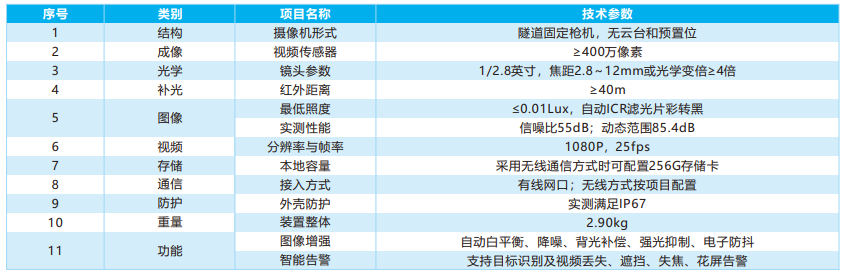
2. Adjustable field of view for channel installation: Camera resolution of at least 4 million pixels, focal length of 2.8–12 mm, or optical zoom of ≥4x;
3. Depth lighting in dark environments: Infrared range ≥ 40 m, suitable for straight tunnels and manhole entrances;
4. Automatic day/night switching: Minimum illumination ≤ 0.01 lux; the automatic ICR filter switches from color to black-and-white;
5. Suitable for high-contrast scenes: signal-to-noise ratio of 55 dB, measured dynamic range of 85.4 dB;
6. Smooth continuous recording: Supports 1080p, 25 fps video, making it easy to review changes in personnel and equipment status;
7. Proactive Alerts for Image Anomalies: Supports alerts for video loss, obstruction, out-of-focus images, distorted screens, and target recognition;
8. The connection method is selected based on site conditions: A wired Ethernet port is typically used, while wireless connections can be configured according to the project;
9. The wireless solution supports caching: When using wireless communication, a 256G memory card can be configured;
10. Compact design facilitates installation in tunnels: The unit weighs 2.90 kg, and the housing has been tested to meet the IP67 rating.
IV. Product Specifications