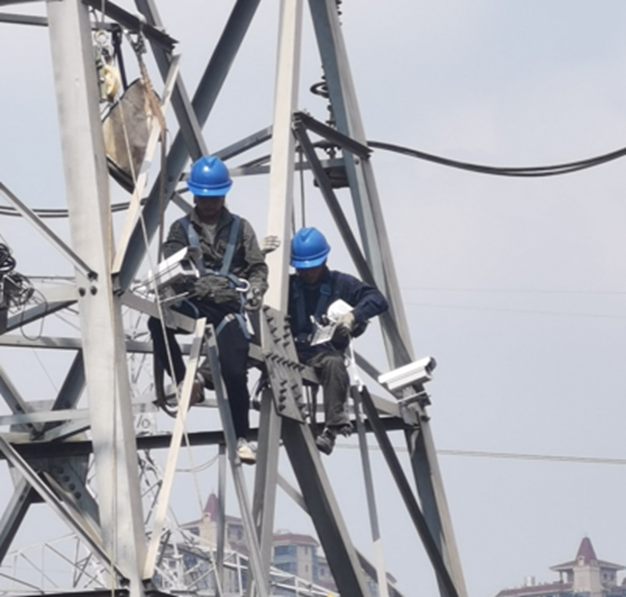
How grueling is it to protect the power grid from external damage, wildfires, and tree obstructions? Manual inspections require climbing mountains and crossing ridges every day to check the lines—it’s exhausting and prone to oversights. Standard 24-hour video surveillance equipment is both expensive and power-hungry, making large-scale deployment simply unfeasible. Dingxin Smart’s Intelligent Monitoring and Recording Device for Transmission Line Corridors was developed precisely to resolve this dilemma. Its key selling points are affordability, ease of use, and scalability—replacing manual patrols with front-end AI.
How does this thing work?
The principle is actually quite simple. A smart monitoring device for power transmission line corridors is mounted on a steel tower or utility pole; it has a solar panel on top to charge itself. It remains on standby most of the time and takes a photo or records a short video at set intervals.
Here’s the key point: it’s equipped with AI algorithms that allow it to “process” the images internally after taking them. Only if it detects a crane, an excavator, smoke, or foreign objects caught in the lines does it transmit the images and alarm information back to the backend via a dedicated 4G/5G network. If everything is normal, it remains in standby mode. This not only saves on data costs and battery life but also spares the backend staff from having to sift through hundreds of useless images—making things much easier for them.
Several key selling points—all honed through real-world experience.
1. The real test of quality is clear nighttime footage: Older night vision cameras would produce nothing but black-and-white, grainy images at night—you couldn’t even make out a license plate. The smart surveillance system for power transmission line corridors uses starlight-level full-color night vision, delivering 8-megapixel or 16-megapixel high-definition images during the day and 2-megapixel color images at night, even in low light. If someone is stealing utility poles or conducting unauthorized construction in the middle of the night, it’s all crystal clear.
2. Only transmit useful images to avoid wasting data: It can automatically recognize objects such as cranes, excavators, smoke, and wildfires. The system also supports security measures for data exchange, including encryption and identity authentication; it supports APN data transmission.
3. Power consumption has been minimized to the absolute minimum: What’s the biggest fear for field equipment? Running out of power. The smart monitoring and imaging device for power transmission line corridors has an online standby power consumption of just 0.2 W and uses 1.2 W per snapshot. Even if you set it to take a photo every minute, it will still last a long time.
4. Multiple Ports: Don’t think of it as just a camera—the main control unit has plenty of ports. If you want to add a micro-weather monitoring system, a tower tilt sensor, or a speaker for audible and visual alarms in the future, you can simply plug them in and start using them right away—no need to run new wires.
5. Easy Installation: Field technicians dread heavy equipment when climbing towers for installation. This unit (including the solar panel and mounting bracket) weighs less than 10 kilograms. With an IP66 protection rating, it can withstand heavy rain and hail. It operates reliably in temperatures ranging from -40°C to +70°C.
As for power, it features a 20W solar panel paired with a 10Ah battery. To be honest, even if it were to go half a month without seeing the sun due to continuous rain and overcast skies, it could still function normally using the stored power.
The Most Frequently Asked Questions
Q: How is this different from the old 24-hour video surveillance systems?
A: There’s a huge difference. The old system was “blind recording”—it wasted electricity and data, and required someone to constantly monitor the screen. This one is “smart monitoring,” where the front-end AI automatically identifies potential hazards and only transmits images that trigger an alert. It offers much better value for money and is ideal for bulk installation along an entire line.
Q: Can you really see clearly at night?
A: Starlight-level night vision is no exaggeration—it delivers full-color images even in low light, which is far superior to older infrared technology.
Q: What if there’s a power outage during a prolonged period of rain?
A: It features intelligent power management. It can last for 15 consecutive days without any light. Even when the battery is completely drained, it will automatically adjust its operations to preserve core functions and won’t shut down completely.