
Quantum information technology is an emerging interdisciplinary field at the intersection of quantum physics and information science, with its physical foundation rooted in quantum mechanics. Quantum mechanics itself was established in 1920 by scientists including Albert Einstein.
Since its inception, quantum science has successively given rise to new technologies such as the atomic bomb, lasers, and magnetic resonance imaging, establishing itself as one of the most significant scientific discoveries of the 20th century.
As we enter the 21st century, the second wave of the quantum technology revolution is imminent.
The second quantum technology revolution will give rise to a range of emerging technologies such as quantum computing, quantum communication, and quantum measurement, which will profoundly transform and enhance humanity's methods and capabilities for acquiring, transmitting, and processing information.
Among these, quantum communication stands as a particularly significant security technology. It employs quantum states as information carriers for data exchange, leveraging the properties of individual photons being indivisible and the principle of quantum non-clonability. This ensures, in principle, that unauthorized parties cannot replicate or intercept information transmitted through quantum channels, thereby guaranteeing secure data transmission.
The three fundamental principles of quantum information: quantum bits, quantum superposition, and quantum entanglement.
1. Quantum Bit: The bit is the fundamental unit of information in classical computers, representing either 0 or 1. A quantum bit (qubit) is the smallest unit of information storage in quantum computers. A single qubit can represent 0, 1, or a superposition of both—meaning it can exist in a state that is a superposition of 0 and 1 in any proportion. Consequently, a qubit contains far more information than a classical bit, which can only represent 0 or 1 (see figure below).
2. Quantum superposition: This refers to a quantum system existing in a superposition of different quantum states. The "Schrödinger's cat" theory once vividly described this phenomenon as "a cat being both alive and dead at the same time."
3. Quantum entanglement: When two quantum particles become entangled, one affects the other regardless of distance or other factors. In short, no matter how far apart they are, the two particles maintain a correlated interaction.
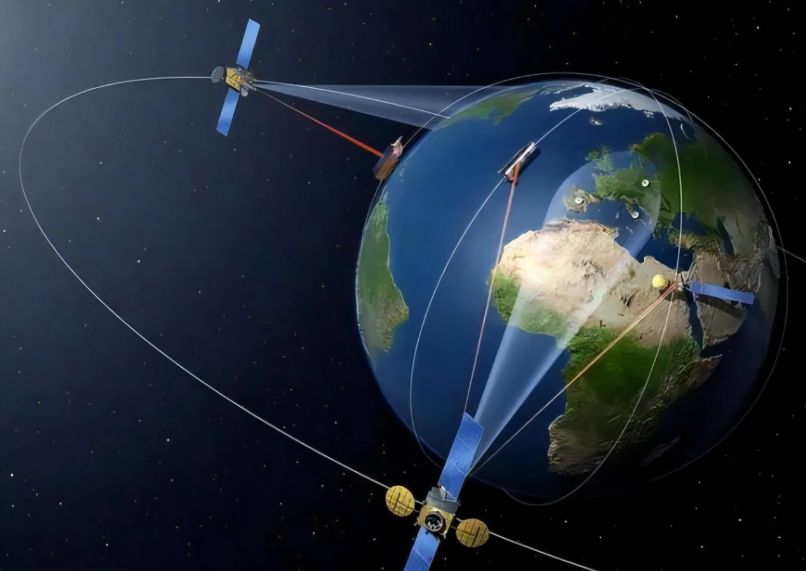
Quantum communication is a method of transmitting information by utilizing quantum states to carry the data and employing quantum entanglement as the channel to transfer these quantum states from location A to location B.
Compared to traditional communication methods, quantum communication offers advantages in ensuring information security, increasing information transmission capacity, enhancing transmission efficiency, and demonstrating strong resistance to interference. It is the most mathematically rigorously proven secure communication method to date.
Quantum communication is categorized into two types based on whether the transmitted information is classical or quantum: quantum key distribution and quantum teleportation.
1. Quantum Key Distribution (QKD): Enables secure key sharing between information senders and receivers, achieving secure communication through a one-time-pad encryption method. Leveraging quantum properties of unpredictability and non-clonability, it ensures information cannot be eavesdropped upon. First, it establishes a secure key sharing channel between parties that is impervious to eavesdropping. Subsequently, it integrates with traditional confidential communication technologies to encrypt/decrypt and securely transmit classical information. This represents the mainstream and most mature industrialized technology approach currently available on the market.
2. Quantum State Teleportation (QT): Direct transmission of quantum state information achieved through the distribution of quantum entangled states and quantum joint measurements, without physically moving the information carrier during transfer. Similar to classical communication, long-distance quantum communication suffers from entanglement decay. Therefore, quantum repeaters must be established to ensure uninterrupted quantum communication. This technology remains in the frontier research stage, with practical implementation still facing challenges.