
When we enjoy air conditioning on sweltering summer days, warm heating during bitterly cold winters, or bright lights late into the night, it's all made possible by the relentless efforts of the power grid. As the scale of renewable energy integration continues to expand, traditional transmission lines face the dual challenges of insufficient transmission capacity and wasted idle capacity. During peak electricity consumption periods, dispatchers can only control transmission loads based on conservative static limits, often leading to bottlenecks where "there is electricity but it cannot be delivered, and demand exceeds supply." This not only affects power supply reliability but also hampers the efficient integration of renewable energy. The Dynamic Load Expansion and Online Monitoring System for Transmission Lines functions like installing an intelligent brain and real-time health monitor for these "power arteries." It precisely unlocks line potential while fortifying safety defenses, becoming a critical pillar in the smart grid transformation journey.
Dingxin Smart Technology's Dynamic Capacity Expansion and Online Monitoring System for Transmission Lines, also known as the Temperature Online Monitoring Device, primarily consists of front-end sensing equipment, a data transmission network, and a back-end monitoring platform. The equipment meets modular and standardized requirements, with sufficient reserved channels to facilitate expansion of temperature receivers and sensors. The system's core lies in the deep integration of "online monitoring" and "dynamic capacity expansion data support." These two functions complement and synergize with each other, enabling real-time line monitoring while precisely unlocking the line's idle potential, thereby breaking the limitations of traditional transmission models.
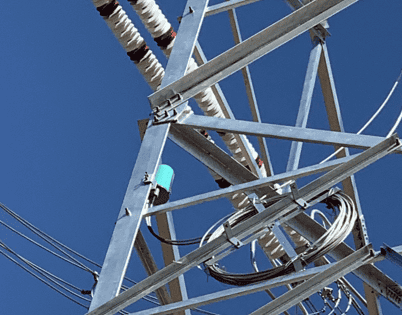
Its core functions can be summarized in two points:
1. Real-time online monitoring:
The system provides 24/7 monitoring with automatic temperature detection for conductors and joints (clamps). It immediately issues alerts for abnormal overheating caused by loose joints, oxidation, or excessive load. Users can view real-time data via web or mobile platforms.
2. Scientific Dynamic Capacity Expansion
Traditional transmission lines are designed with fixed standards (conservative values) to limit current flow. However, in reality, during high wind speeds and low temperatures, conductors dissipate heat more efficiently, enabling higher current transmission. By continuously monitoring real-time data such as conductor temperatures, the system calculates the maximum load the line can handle under current conditions—a process known as "dynamic capacity increase." This means that without replacing conductors or reinforcing towers, precise data calculations directly replace traditional static rated current capacity. This enables flexible load adjustment, legally and compliantly boosting the line's transmission capacity. To some extent, this addresses localized electricity supply constraints.
This system serves as both a safety sentinel monitoring overheating risks and a core technological device that leverages data mining to uncover the remaining transmission capacity of power lines, thereby enhancing grid operational efficiency and ensuring power supply reliability.