
Outdoor live electrical facilities and equipment have long been characterized by issues such as wide coverage and scattered locations. Furthermore, manual inspections have blind spots, and some static warning measures are ineffective. The root cause lies in the fact that traditional static warnings can only provide passive alerts and lack the ability for active detection and intelligent early warning. Traditional prevention and control models that rely solely on reflective signs, paper posters, and manual monitoring cannot provide 24/7 protection nor cover safety blind spots in complex outdoor environments. To prevent external damage risks at their source, we need a “smart power sentinel” that never goes off duty and remains online around the clock. Dingxin Smart Technology’s smart anti-external damage warning sign is specifically designed for power grid protection scenarios, perfectly addressing the challenge of ineffective warnings in low-visibility conditions such as at night, during rain or cloudy weather, and on construction sites.
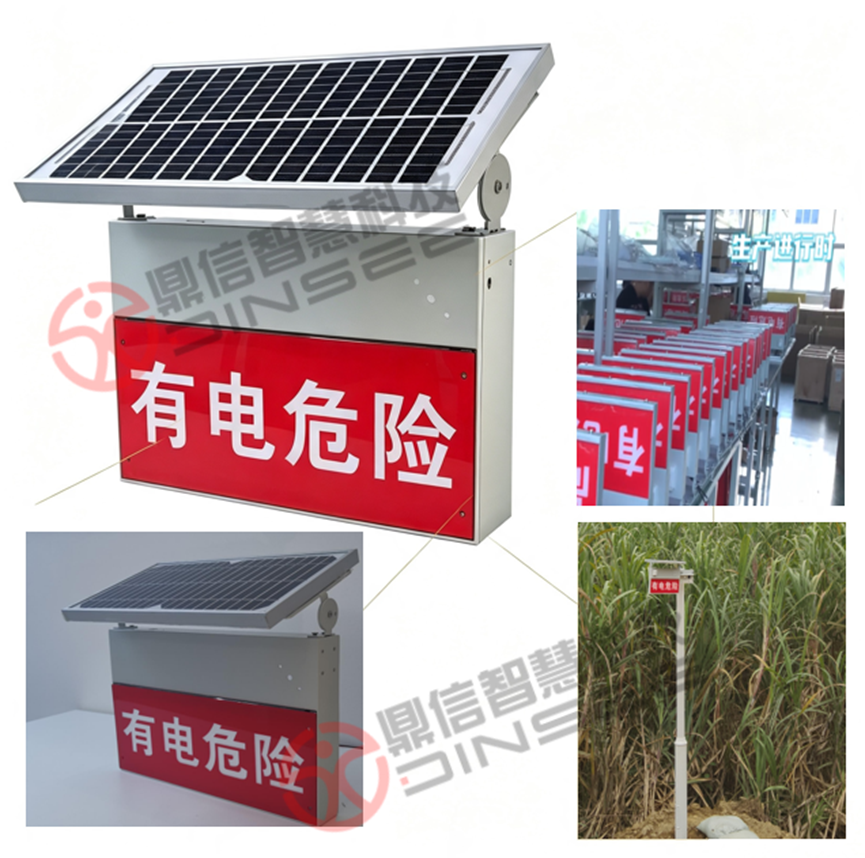
The smart external damage prevention warning sign integrates a high-brightness light-guiding warning panel, solar power plus a high-capacity battery, smart sensors, a speaker, an RFID smart inspection unit, and an integrated control board. It requires no manual monitoring and provides fully automatic detection and early warning, making it suitable for installation on city streets, rural utility poles, and outdoor power distribution rooms.
Equipped with a built-in high-sensitivity sensor module, the device immediately triggers an alert as soon as vehicles, construction machinery, or pedestrians enter its detection range of approximately 10 meters, transforming the traditional “waiting for people to notice the sign” approach into a system where the device proactively issues warnings. Unlike ordinary constantly lit warning lights, it provides time-based, differentiated alerts, balancing warning effectiveness with residents’ quality of life:
Loud, clear voice announcements during the day; warning messages can be customized as needed, with the ability to freely switch between warning content (supports updating announcement scripts via a USB cable). Customized warning messages can be tailored for various scenarios—such as substations, transmission towers, cable corridors, and construction barriers—to meet frontline operations and maintenance needs. Examples include: “Live wires—danger, do not approach”; "High voltage—danger, do not climb"; "Substation area—do not approach"; "Under high-voltage lines—fishing prohibited"; "Value life—beware of electric shock"; "High voltage—danger, do not approach"...)
It supports a silent mode at night, automatically mutes audio, and switches to light alerts, ensuring no noise disturbs residents. It provides clear visibility over long distances even in the dark, during heavy fog, or in heavy rain. In terms of power supply, the device features a built-in solar panel and a high-capacity internal battery. It charges automatically with daily sunlight, making it energy-efficient and eco-friendly without the need for external wiring. Installation is simple, allowing it to operate reliably in locations without power sources—such as in the wilderness, on utility poles in remote villages, or at temporary construction barriers.
It can be used not only in power-related applications but also in various types of hazardous areas.
In addition to being used by power utilities to protect outdoor electrical facilities and equipment—such as transmission towers, utility poles, transformers, and ring main units—this smart warning system has numerous practical applications, such as demarcating restricted-access areas at large construction sites and around warehouses; providing collision protection for telecommunications base stations; and deterring people from fishing or climbing utility poles near high-voltage power lines in fish ponds and forested areas.
In the past, we relied on reflective tape and metal warning signs for protection, which meant we could only wait for outsiders to notice the danger on their own. After installing smart anti-external-impact warning signs, the devices can autonomously detect hazards, actively flash, and issue voice alerts, moving early warning to the forefront—shifting from “waiting to be seen” to “proactively alerting.” These small, smart devices address the shortcomings in outdoor smart warning systems, thereby reducing the occurrence of electric shock and accidents caused by external damage.