
Is abnormal sag the root cause of frequent power line failures? Yes, sag is a troublesome parameter. Rising temperatures and heavy line loads cause the conductors to stretch and sag, resulting in increased sag; conversely, during cold winters, the conductors contract and become taut, causing the sag to decrease significantly. Although calculations on design drawings may be precise, once a line is put into operation and loaded—exposed to scorching summer heat and winter ice accumulation—the actual sag of the conductors often becomes a mystery. In the past, reliance on manual measurements with instruments or rigid calculations based on extreme conditions simply couldn’t keep up with the changing conditions of the line.
Adaptability to Multiple Scenarios
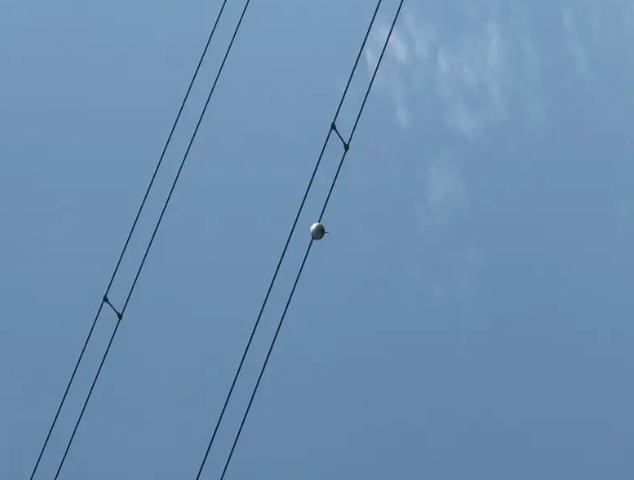
To precisely manage sag-related risks, Dingxin Smart Technology’s Conductor Sag Monitoring Device DX-WPS100-HC is specifically designed to measure the distance to ground, sag angle, and conductor deviation angle, and can be flexibly adapted to various monitoring locations. To monitor jumper sag, the sensor can be mounted directly on the jumper; to monitor insulator sag, the sensor is installed at both ends of the insulator string; and to monitor sag between adjacent spans, the device is deployed directly between the conductors of the two phases.
The device is based on laser sensing and low-power wireless technology, combined with a high-voltage power harvesting solution to ensure stable battery life. It collects real-time sag data around the clock and transmits it simultaneously to the monitoring center via multiple channels, including 4G, 5G, GPRS, Wi-Fi, and OPGW fiber optics. If any monitored value exceeds the preset safety threshold, the system will immediately trigger a remote alarm.
Fully Featured
The device offers flexible data collection modes, divided into two categories: automatic scheduled collection and remote-controlled collection. It can not only automatically collect related parameters—such as inclination, temperature, and tension—according to preset cycles but also receive commands from the backend to adjust the collection time period, interval, and number of data points at any time. The terminals can simultaneously collect data on their own power supply voltage and internal operating temperature, providing real-time insight into the equipment’s operating conditions. They feature built-in network time synchronization, automatically receiving daily time synchronization commands from the system. The daily time deviation is less than 1 second, and the error for a single synchronization event is kept within 5 seconds, ensuring that the clocks across the entire system remain synchronized.
The system features built-in data preprocessing algorithms that can automatically identify and filter out interfering data. It can also perform calculations based on raw parameters such as inclination angle, temperature, and imagery to generate intuitive and easy-to-understand metrics for sag and ground clearance. With ample local storage capacity, it can retain status data for more than 30 days on a cyclical basis.
Real-world scenarios
From a practical implementation perspective, conductor sag detection devices are best suited for installation on sections with large spans crossing roads, railways, or rivers; new energy transmission lines; lines subject to heavy loads during the summer; and high-risk sections where trees grow densely beneath the lines. At the same time, it is important to objectively recognize the limitations of the equipment: the device calculates sag based on the orientation of the suspension points combined with a mechanical model. If localized anomalies occur in the middle of a span—such as broken conductor strands or localized entanglement with foreign objects—it is necessary to use video or radar equipment for cross-verification.