
For surge arresters in the power grid, online monitoring is not merely a nice-to-have feature—it is a protective measure that helps prevent problems before they occur.
A large number of surge arrester failures occur without any obvious external signs. For example, a set of 110 kV metal-oxide surge arresters (MOA) at a substation might have shown completely normal results during preliminary testing at the beginning of the year, with resistive currents all within normal ranges. However, once the thunderstorm season of the same year has passed, an infrared scan might reveal that the temperature of the B-phase body is already significantly higher than that of the A and C phases. At this point, there is a high probability that the internal valve discs already exhibit obvious signs of surface burning. If the annual pre-test cycle is followed, this set of surge arresters will most likely fail before the next test is conducted.
For outdoor steel tower power lines, when struck by lightning during a thunderstorm, massive lightning currents rapidly travel down the tower. If the tower’s grounding system is intact and its resistance meets standards, the current can be safely dissipated into the ground without causing a failure. However, because outdoor towers are exposed to the elements year-round—including wind, rain, soil corrosion, and foundation settlement—the grounding electrodes can corrode, become buried to the point of failure, or cause grounding resistance to exceed acceptable limits. In such cases, the lightning current cannot be rapidly dissipated, causing the tower to instantly accumulate extremely high voltages that directly break down the surrounding insulators, leading to line flashovers and short-circuit tripping. Open areas such as mountaintops, open fields, and high ground are particularly prone to lightning strikes, making lightning protection risks even more pronounced.
Precision-targeted solutions to address maintenance challenges for lightning arresters on communication towers and address shortcomings in power line lightning protection: Dingxin Smart Technology’s Online Lightning Arrester Monitoring System DX-WPS100-BL is specifically designed for monitoring the health of power grid lightning arresters. It features data acquisition, analysis and diagnosis, web-based viewing, and remote communication capabilities. Installed directly on the lightning arrester, it meets all measurement accuracy requirements. Online monitoring of surge arresters is not a particularly complex technology; in principle, it involves accurately measuring current, transmitting the data back, and interpreting the trends.
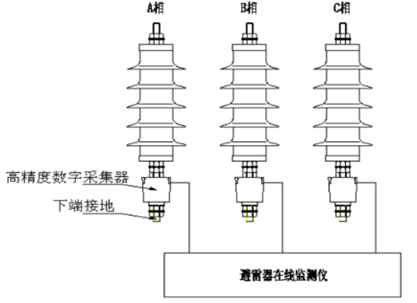
The device’s standout feature is that it requires no external power supply and no routine maintenance, revolutionizing the power supply limitations of traditional monitoring equipment. By innovatively harnessing energy from the leakage current of surge arresters, the device completely eliminates the need for solar panels or lithium-ion batteries, thereby reducing equipment failures and minimizing long-term maintenance efforts at their source—making it ideal for long-term, unattended outdoor operations. At the same time, it employs fully isolated, zero-residual-voltage sampling technology, ensuring that the monitoring process does not interfere with the normal operation of the surge arrester. This not only guarantees the stable operation of power equipment but also eliminates potential safety hazards to personnel, maximizing safety.
To adapt to complex field conditions, the surge arrester online monitoring system is equipped with a dual-power supply system that combines solar power with eco-friendly lithium-ion batteries. Paired with an intelligent SOC (State of Charge) control system, it precisely regulates energy consumption, effectively coping with extreme environments such as overcast or rainy days and conditions with no sunlight, ensuring stable year-round operation of the system. To address the unique environment of strong electromagnetic interference along transmission lines, the device incorporates multiple built-in anti-interference mechanisms capable of shielding against various types of electromagnetic signal interference. This ensures accurate data collection and stable device operation, making it suitable for all high-voltage transmission scenarios.
In terms of data transmission and operational efficiency, the equipment offers significant advantages. Leveraging mature GPRS/GSM wireless networks, it enables real-time, online, wireless remote transmission of lightning protection data. Operations and maintenance personnel can remotely view the operational data for each set of MOA surge arresters through the backend system, allowing them to accurately monitor the equipment’s health status.
The system supports comprehensive batch installation, enabling centralized, intelligent monitoring of all surge arresters along an entire transmission line, thereby completely eliminating the delays and limitations associated with manual inspections. Not only does this significantly improve the efficiency of surge arrester monitoring along transmission lines, but it also identifies potential failures in surge protection equipment in advance, proactively preventing lightning-induced tripping and equipment damage, and ensuring the safe and stable operation of transmission lines in every respect.