
A large number of utility poles and towers are located on hillsides, in valleys, and along rivers, where they are constantly exposed to rain erosion, foundation settlement, slope slippage, and disturbances from external construction activities. As a result, many pole collapse incidents do not occur suddenly; rather, the foundation gradually deforms and the poles or towers gradually tilt. These hidden hazards can remain dormant for weeks or even months until a heavy rainstorm or strong wind directly triggers pole collapses, broken wires, and circuit trips.
In the past, managing this type of risk relied primarily on O&M personnel conducting regular line inspections, but the time between inspections created a safety blind spot for “tower tilt.” Some towers have already begun to show early, subtle signs of tilt that are not visible from the outside. By the time this is detected during a manual on-site inspection, the tower is already very close to losing stability, leaving very little time for corrective action.
Dingxin Wisdom’s DX-WPS100-QJDual-Axis Inclinometer Tower Tilt Monitoring Device addresses this practical challenge. The device employs the inclinometer monitoring principle and utilizes industrial-grade inclinometer sensors to accurately measure the tower’s lateral, longitudinal, and composite tilt angles. It has a measurement range of ±10° and achieves a measurement accuracy of ±0.05°. By combining data from two axes—longitudinal angle changes caused by variations in wire tension and forward/backward slippage at the tower base, and lateral angle shifts resulting from unilateral foundation settlement and lateral thrust from slopes—the system calculates a composite tilt angle to accurately reconstruct the tower’s actual tilt posture. This approach is significantly more precise than measuring changes in a single direction and can be deployed at a large number of locations, including distribution network concrete poles and standard steel towers.
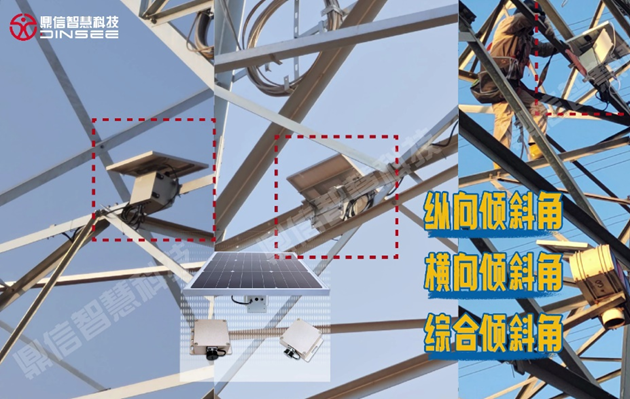
The entire unit features a sealed metal housing that meets outdoor protection standards and is designed to operate in temperatures ranging from -40°C to +70°C. Power is supplied by solar panels paired with a lithium-ion battery, enabling long-term autonomous operation in remote locations without an external power source, eliminating the need for frequent trips up the mountain to replace batteries. It is mounted using multi-purpose clamps secured to the main structure of utility poles, and can be retrofitted directly onto existing older utility poles.
The collected angle data is transmitted back to the backend platform via wireless networks or dedicated power grid networks, and BeiDou functionality can be added based on user requirements. Operations and maintenance personnel can intuitively view the real-time orientation, angle values, and historical trend curves for each tower directly on the platform. The device does more than simply report angle values; its primary focus is on trend analysis. On-site personnel can set multi-level alarm thresholds in accordance with line operation and maintenance standards. The system not only monitors whether the instantaneous tilt angle exceeds the threshold but also tracks the rate of change in the tilt angle. For example, if the angle continues to increase over a short period—even if the absolute value has not yet reached the critical threshold—an early warning can be triggered to alert maintenance personnel to pay close attention. The backend stores complete historical data curves, allowing users to review data spanning weeks or months to determine whether the tilt has stabilized or is continuing to worsen. This helps O&M personnel distinguish between normal wind-induced vibrations and genuine geological hazards. Alert notifications can be pushed to the backend platform and O&M personnel’s mobile devices, clearly specifying the tower ID, location, tilt angle, and trend, eliminating the need for O&M personnel to blindly search the mountains for potential hazard points.
In actual field applications, the tower tilt monitoring device is ideal for the bulk deployment of monitoring points at high-risk tower locations—such as landslide edges, riverbank erosion zones, subsidence areas caused by mining, and areas surrounding construction disturbances—thereby reducing operational and maintenance burdens.