
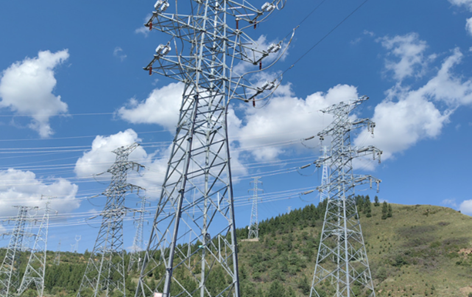
Not every monitoring point along an overhead line requires a full-range inspection. At some locations, potential hazards are consistently concentrated in a specific direction—such as at crossing points, construction access points, and beneath utility poles. For these areas, it is sufficient for the surveillance cameras to remain focused on the same work area at all times.
In this situation, a pan-tilt camera system would actually create additional problems. During monitoring, the lens might temporarily lose sight of the critical area, causing it to miss the exact moment an anomaly occurs. The mechanical pan-tilt mechanism also requires regular maintenance, and long-term operation places an additional burden on the power supply. For locations that only need to monitor a single direction, these costs are not worth it.
Dingxin Smart Technology’s Overhead Power Line Image and Video Monitoring Device (Gun-Type) DX-WPS100-JP takes the opposite approach: the lens orientation is set once during installation and remains fixed once the device is operational. The forward-facing night vision channel monitors key areas, the wide-angle channel records the full scene, and the downward-facing lens inspects the area beneath the towers and the immediate vicinity of the equipment. Since the footage is always captured from the same angle, before-and-after comparisons become straightforward. If a tree is in a certain position today, and the same angle is used to capture the scene a month later, any changes are immediately apparent.
The value of this stable reference point is most evident in periodic snapshots and the documentation of anomalies. Devices can capture images at preset intervals or be triggered remotely by the platform. Once a device detects a target of interest, it saves an image or a short video clip and uploads it via 4G. Because the frame of reference remains fixed, multiple images taken from the same location can be directly overlaid and compared without the need for prior angle correction. For slow-moving processes such as tree growth, construction progress, and ground subsidence, a series of images taken from the same angle provides more valuable insights than a single panoramic survey.
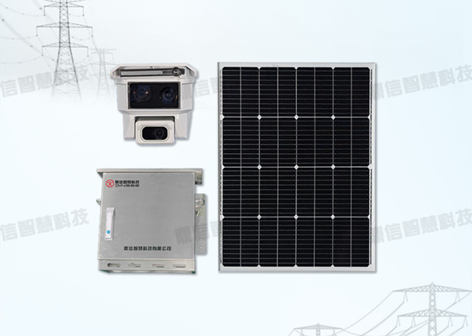
In terms of imaging configuration, it features a 4-megapixel forward-facing night vision camera, an 8-megapixel forward-facing wide-angle camera, and a 4-megapixel downward-facing wide-angle camera, with an effective visible-light resolution of ≥16 million pixels and multi-camera visual data acquisition. The forward-facing wide-angle camera has a 105-degree field of view, while the downward-facing wide-angle camera has a 110-degree field of view, covering both the construction area and the area beneath the tower. The minimum illuminance is ≤0.01 lux, with night vision support and a measured dynamic range of 80.6 dB, ensuring that effective information is retained in both high-contrast daytime scenes and low-light nighttime conditions.
In terms of image capture mechanisms, the system supports multiple modes, including scheduled capture, alarm-triggered capture, and remote capture. It transmits high-quality 1080p video and can automatically save on-site footage upon an alarm. The device features 32GB of local storage—rewritable up to 520 times—for storing images and alarm logs. 4G connectivity is suitable for periodically uploading images from a fixed direction, eliminating the need for continuous, high-bandwidth data transmission.
In terms of power supply, the system features a 30W solar panel paired with a 200Wh lithium iron phosphate battery, with a peak power consumption of 13.5W. Compared to devices equipped with a gimbal, this design eliminates the power consumption associated with the rotating mechanism, resulting in less overall strain on the power supply. The main unit weighs 5.0 kg, and the entire system weighs 32.0 kg. The housing has been tested to meet the IP67 standard, making it suitable for installation on utility poles.
The trade-offs in the design of fixed-field-of-view equipment are clear: sacrificing omnidirectional patrol capabilities in exchange for a stable monitoring reference and a lower operational burden. This trade-off makes sense at specific locations. Overpasses require long-term comparison of clearance changes along the same cross-section; construction entrances require continuous recording of machinery activity in the same direction; and areas beneath utility poles require close-range observation from a fixed viewpoint. What these scenarios have in common is that potential hazards do not move elsewhere, so the camera does not need to track them.
The choice of monitoring method depends on the question to be answered. If the question is “How does the condition of this area change over time?”, the continuous images from a fixed field of view—which are relative to a fixed reference point—provide a more direct answer than the flexible but reference-drifting images from a patrol view. Sometimes, staying still is precisely what allows for a clearer view.