Every year, when cold snaps bring rain and snow, power transmission lines in high-altitude areas and regions with microtopography face the challenges posed by ice accumulation. As rain ice and rime ice continuously build up on the surface of the conductors, the load steadily increases, leading to circuit breakers tripping and flashovers in mild cases, and broken lines and fallen towers in severe cases. This is a major hurdle that cannot be avoided in the annual efforts to combat ice accumulation and ensure a stable power supply.
In the past, on-site response measures were extremely limited. Manual ice inspections required venturing into deep, mountainous, and treacherous terrain; once rain or snow cut off access to the mountains, it was difficult for personnel to reach the site, and by the time ice conditions were observed, it was often already too late. Traditional tension monitoring devices required connection to live conductors or insulator strings; retrofitting aging lines necessitated power outages. With multiple monitoring points required per line, coordinating power outage windows and organizing construction resulted in lengthy cycles and high coordination costs. Image-based monitoring can only capture the surface layer; during dense fog, at night, or when the lens is frosted over, the reliability of the identification results is significantly reduced. Fiber-optic sensing solutions offer considerable monitoring accuracy, but they require modifications to existing conductors, making large-scale deployment on existing lines difficult.
Many operations and maintenance units have faced a practical challenge: they manage a vast number of existing transmission lines, with ice-related risk points scattered across the network, yet lack the resources to frequently shut down power lines for retrofitting. The need to obtain accurate and reliable icing data without disrupting the existing transmission infrastructure has forced a shift in monitoring strategies—rather than retrofitting the live conductors themselves, a system of “environmental surrogates” is installed on the towers to simulate conductor icing detection nodes.
Dinsee Smart Technology DX-WSP100-GBPower Transmission Line Simulated Icing Monitoring Device—this system is mounted directly on the crossarms of transmission towers, making no contact with live high-voltage conductors throughout the process. It requires no power outage and involves no dismantling, replacement, or modification of the existing line. Simulated conductors made of the same material and with the same outer diameter as the actual on-site conductors are selected as sensing carriers. They are exposed to the exact same outdoor microenvironment as the real conductors—with synchronized temperature, humidity, supercooled droplets, and wind conditions—ensuring that the processes of ice formation, accumulation, and melting closely mirror those of the live conductors.
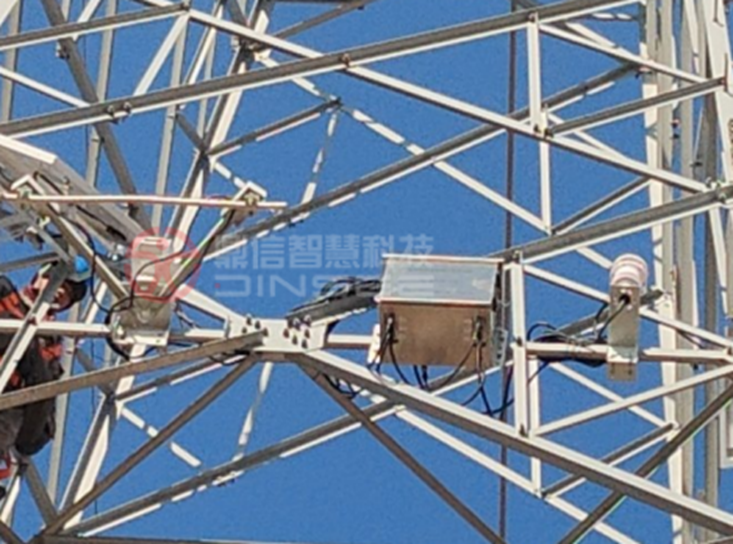
On-site installation allows for lightweight and rapid deployment. Once workers climb the tower, they simply need to secure the mounting bracket, install the simulated conductor unit, and connect the power and communication modules. A single unit can be fully assembled in a short amount of time, without the need to dismantle hardware or disturb the conductors. This feature is particularly useful for aging power lines in mountainous areas and critical corridors where power outages cannot be easily authorized. There is no need for large-scale, line-wide interventions; instead, sensing nodes can be deployed on an as-needed basis specifically at key towers with a history of frequent icing, prioritizing coverage of high-risk locations and avoiding the time and financial pressures associated with large-scale retrofits.
The sensing node incorporates a high-precision tension sensor that captures the increase in weight of the analog wire after ice accumulation. By combining this data with on-site micro-meteorological measurements—including temperature, humidity, wind speed, and wind direction—and applying on-site operating condition calibration, the system calculates the equivalent ice thickness. At the same time, when paired with a visualization acquisition unit, the actual shape of the ice layer is transmitted in real time to the backend, allowing the mechanical weighing data and live video footage to cross-verify each other. This reduces misjudgments caused by strong wind disturbances and wet snow accumulation, addressing the long-standing issue of distortion associated with single-method monitoring.
In field conditions, the equipment utilizes solar power combined with high-capacity energy storage batteries, making it suitable for long, overcast, and low-light winter conditions and ensuring uninterrupted data collection during freezing periods. Data is transmitted via a dedicated network or 4G (supporting multiple modes, including 4G, 5G, Wi-Fi, and LoRa). Users can access ice thickness trend curves and on-site live footage at any time through the operations and maintenance backend or mobile app. The system automatically sends alerts when thresholds are reached, allowing for continuous monitoring of ice growth trends to prepare for de-icing operations.
Of course, we must also take an objective view of the limitations of this solution. The simulated conductors serve as an equivalent representation on the tower side; they are better suited for supplementary monitoring along the line and installation in sections with a high risk of ice accumulation, working in conjunction with tension monitoring of the conductors themselves to form a comprehensive ice detection system.