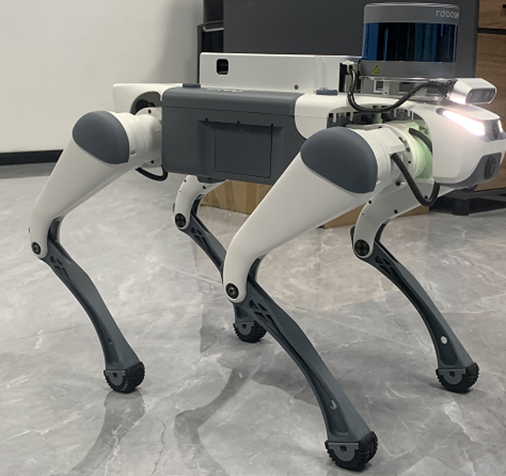
Substation inspections have always been a grueling task, especially in areas with complex terrain, where traditional wheeled robots often get stuck or slip. To address this challenge, Dingxin Smart Technology has launched the DX-RBT100-R1Power-Driven Legged Inspection Robot (Robot Dog). This is a four-legged intelligent inspection device designed for all scenarios in substations. It cuts through the hype—its core promise is “go anywhere, perform well wherever it goes”—efficiently handling all inspection tasks inside and outside the substation.
The features and benefits are as follows:
1. Don’t “be picky about routes”
Substations are full of cobblestones, grassy areas, and even steep slopes, steps, and thresholds. Ordinary wheeled robots are essentially helpless on this kind of unstructured terrain, but the DX-RBT100-R1 powered legged inspection robot is designed specifically for these conditions. Not only can it walk and run, but it can also jump right over ditches and ruts, and even if it accidentally slips and falls, it can get back up on its own. Most importantly, it requires no modifications to the site environment; it can move directly from outdoors to indoors. A single unit can easily cover a large substation spanning 25,000 square meters, achieving seamless integration between indoor and outdoor operations.
2. Quick to find their way, walk with precision, and plan their own routes
When it arrives at a new station, it doesn’t need to be manually “taught” step by step via remote control. Using its built-in LiDAR SLAM technology, it can “drive” a full lap around the 25,000-square-meter station area and generate a 3D point cloud map in about 20 minutes. With this map, it can autonomously plan omnidirectional navigation routes. Unlike wheeled robots, which can only take detours, it can directly cross obstacles, take shortcuts, and automatically adjust its angle to avoid obstructions—all with virtually no human intervention.
3. Strong edge computing capabilities
It’s not enough for the robot to simply move around—it must also see accurately. The DX-RBT100-R1Power-Driven Inspection Robot features AI computing power integrated directly into its end effector, enabling it to identify potential hazards on-site. Its deep learning algorithms are highly resistant to interference; even when faced with environmental disturbances such as changes in lighting or obstruction by tree leaves, it can accurately identify equipment status and perform infrared temperature measurements. Once a potential hazard is detected, reliable data is immediately transmitted to operations and maintenance personnel. The quality of manual inspections is highly susceptible to subjective factors such as an inspector’s experience, work condition, and sense of responsibility; however, AI-powered hazard detection ensures that the data is objective and accurate.
4. Physically fit, able to endure and run
Don’t let the name “robot dog” fool you—it’s a real “powerhouse” when it comes to work. The entire unit weighs 53 kilograms, and when crouched down, it’s only 34 centimeters tall, making it a breeze for it to squeeze into the narrow space beneath a switchgear cabinet. Plus, its load-bearing capacity allows it to effortlessly carry a 20-kilogram device during routine inspections, and in extreme tests, it can even handle up to 85 kilograms. It can reach a top speed of 4.95 meters per second, and when encountering a 30-degree slope or an 18-centimeter-high step, it simply lifts its leg and strides right over it.
5. Battery life is as advertised
The DX-RBT100-R1 electric legged inspection robot is equipped with a high-capacity 72V battery, providing over 4 hours of operation without a load and over 2 hours with a 20-kilogram load. Even more convenient is its support for “autonomous charging” (optional), which enables truly unattended operation.
6. Wide range of interfaces
The device features a variety of built-in interfaces, including Ethernet, Wi-Fi, USB, and RS485/RS232, and is compatible with external power supplies ranging from 5V to 72V. It essentially functions as a “mobile platform,” and we can add various sensors or more advanced cameras based on the customer’s project requirements, offering maximum expandability.
7. One device can replace multiple devices
In the past, conducting indoor and outdoor inspections might have required purchasing several specialized pieces of equipment, such as wheeled or tracked vehicles, but now a single legged robot can handle it all. This not only significantly reduces procurement costs but also cuts down on the workload associated with manual inspections, offering excellent overall value for money.