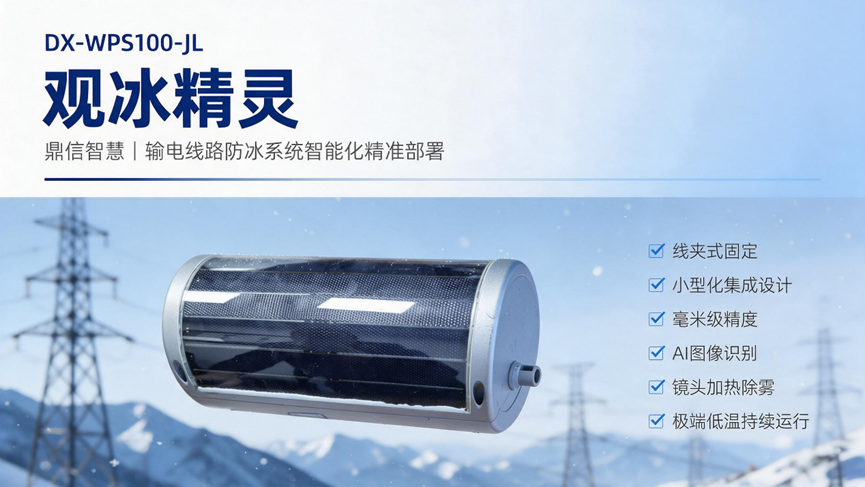
Recently, a number of “Ice Monitoring Devices” have been installed on ultra-high and extra-high voltage power lines, sparking growing curiosity about them. Also known as ice monitoring devices, these compact units are secured directly to the conductors using line clamps. As we enter November, mountainous areas, windy sections, and high-altitude stretches are gradually entering the ice accumulation season. Today, Dingxin Smart will explain their installation methods, ice-detection principles, and early-warning processes.
1. What is the difference between the Ice Spirit and the monitoring devices installed on utility poles?
The most obvious difference is the installation location. The analog ice accumulation simulator on transmission towers is suspended from the crossarm; it uses a simulated conductor of the same specifications to “mimic” ice accumulation on the actual conductor, and then uses a tension sensor to estimate the ice thickness. In contrast, the “Ice Monitoring Elf” is installed directly on the actual conductor and measures the conductor’s own condition. The device features a curved design with an aluminum alloy housing that has undergone anti-corona treatment, preventing significant corona discharge in the strong electric fields found in ultra-high and extra-high voltage environments. It is secured using line clamps and has a compact design; as long as the installation point meets the requirements for insulation clearance and mechanical strength, it can be installed, making deployment relatively straightforward.
II. How is the thickness of ice accretion measured?
The device features a built-in AI module with edge computing capabilities, allowing data to be processed at the front end without having to send everything back to the backend. It collects various hazard-related data in real time—such as the thickness of ice buildup on power lines, current, and temperature—while simultaneously capturing on-site images. It then analyzes the images alongside the sensor data to provide an assessment of the icing conditions. The lens features a heating function that automatically defogs and prevents icing in rainy, snowy, or extremely cold weather, ensuring the captured footage is usable. Compared to relying on a single sensor, the cross-validation of data and images results in fewer false positives and missed detections.
III. How Are Early Warning Alerts Delivered to Operations and Maintenance Personnel?
When indicators such as ice thickness exceed preset thresholds, the platform automatically generates alerts and pushes them to users via WeChat and the web interface, eliminating the need for constant manual monitoring. In terms of communication, the system supports multi-band and multi-network adaptability and can accommodate dedicated network SIM cards, allowing it to utilize whatever network is available on-site—ensuring data can be transmitted even from remote locations.
IV. How are power supply and protection addressed during long-term operation in the field?
The power supply supports high-efficiency AC inductive power harvesting, drawing power directly from the conductors via induction; the specific method is selected based on site conditions. The housing features a double-layer design, with the outer layer incorporating an automatic drainage system to prevent rainwater and melted snow from accumulating inside; the internal core components have a protection rating of IP67 or higher, ensuring they continue to function normally in low-temperature, humid, and freezing rain conditions.
High-altitude cold regions, windy passes, key interregional corridors, and sections historically prone to icing are all key areas where the Ice Monitoring System comes into its own. The earlier ice conditions are detected, the more proactively they can be addressed.