
Incidents involving vehicles coming into contact with power lines occur frequently. However, when the vehicles involved are large trucks and the lines are high-voltage, the result is no longer just a minor scrape but a potentially fatal electrical accident. The primary culprit behind these incidents is the blind spots that large vehicles simply cannot avoid.
Visual blind spots are the core issue
Large vehicles are tall, and there are numerous blind spots around the cab, particularly above the roof, to the rear sides, and on top of the cargo bed. It is difficult for drivers to accurately judge the distance to high-voltage power lines in these areas using only rearview mirrors and their naked eyes. When turning, reversing, loading or unloading cargo, or navigating narrow roads, the vehicle body, cargo bed, or mounted robotic arms can easily come into proximity with high-voltage power lines without the driver noticing.
The consequences of exposure are immediate and severe
If the vehicle body or equipment comes into contact with high-voltage power lines, the current will flow through the metal body, causing the entire vehicle to become electrified. Anyone at the scene who touches the vehicle risks electric shock. At the same time, the electric arc generated by a short circuit may ignite the fuel tank or nearby flammable materials, resulting in vehicle damage and a fire. In areas such as construction sites and urban-rural fringe zones, the height at which high-voltage power lines are installed sometimes fails to accommodate the passage of large vehicles. This, combined with some drivers failing to check for power lines in advance and violating regulations by overloading their vehicles, further increases the likelihood of accidents.
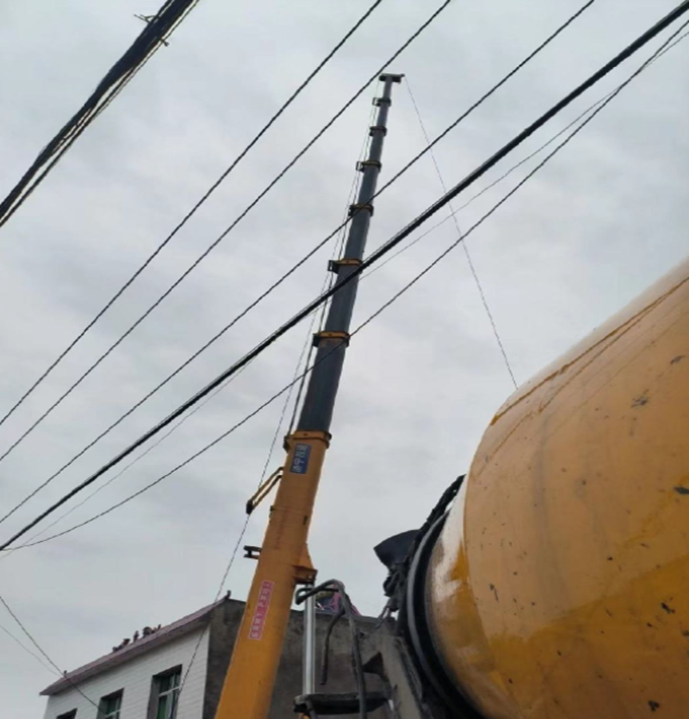
Such incidents are characterized by their sudden onset, severe consequences, and the difficulty of rescue operations, and they have a direct impact on nearby power supply and public safety. To raise safety awareness among drivers, Dingxin Smart Technology’s DX-JDS100 Vehicle Electric Shock and Proximity Alarm provides real-time detection and early warning of proximity to power lines, helping workers avoid the risk of electric shock and prevent accidents.
System Components: The device consists of two parts: the front-end detection unit, mounted on the vehicle's boom or roof, which detects high-voltage power line signals; and the intelligent warning unit, installed in the cab, which receives signals from the front-end unit and issues an alarm.
How it works: The front-end detection unit is programmed with a target voltage level and a safety distance threshold. When it detects a high-voltage line signal and the distance falls below the set value, it transmits the signal via 2.4 GHz wireless communication to the warning control unit in the cab. The control unit immediately issues a voice alert stating, "High voltage hazard—do not approach," prompting the driver to adjust their position.
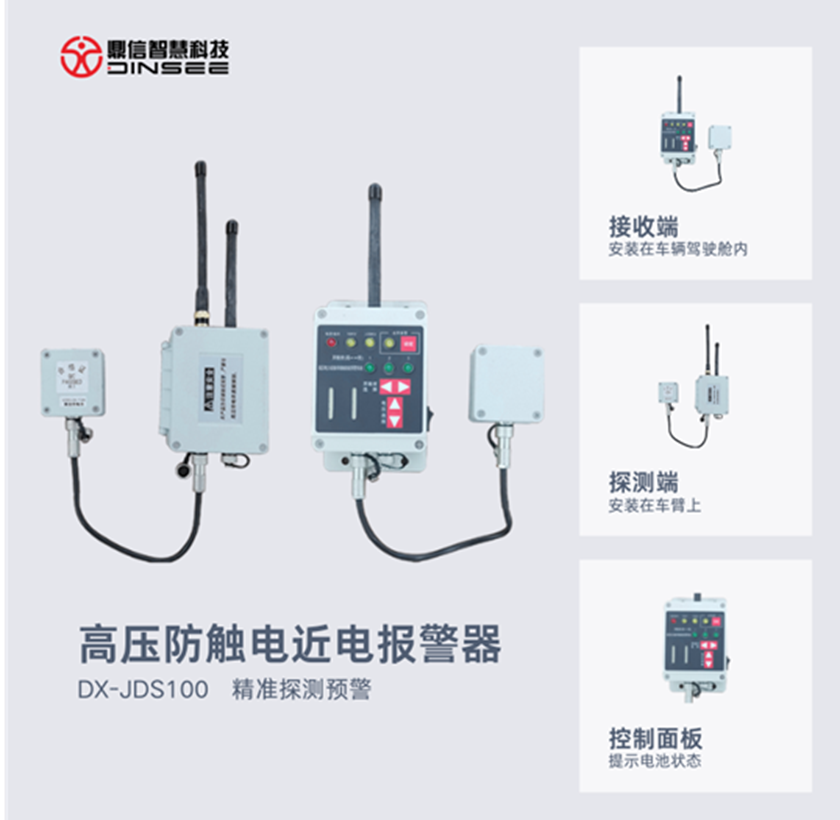
Key Parameters
1. Supports voltage levels of 10 kV, 35 kV, 110 kV, 220 kV, and higher;
2. 2.4 GHz wireless communication, with an unobstructed transmission range of ≥200 m;
3. The front detection unit is attached to the vehicle arm using magnets or wire, making it easy to install and remove;
4. The equipment can be installed and removed for use on multiple vehicles; it is not limited to use on a single vehicle.
Practical value
The challenge in preventing near-miss incidents involving large vehicles and power lines lies in the fact that drivers, while working, focus their attention on the task at hand, making it difficult for them to simultaneously monitor the distance to overhead and side-mounted power lines. A near-miss alarm system shifts the assessment of distance from “visual estimation” to “real-time detection by the device.” Drivers no longer need to frequently look up to check the position of power lines; instead, the device automatically sounds an alarm when the distance becomes insufficient, effectively creating an electronic barrier between the work boom and the high-voltage lines.
Its versatility is another practical advantage. Support for multiple voltage levels means a single set of equipment can be adapted to meet the operational needs of different sections of power lines; the installation method—which uses magnets to attach the device and secures it with wire—allows the equipment to be quickly transferred between different vehicles, making it suitable for shared use across an engineering fleet. For construction companies that frequently work beneath high-voltage power lines, this low-cost, reusable warning system is more reliable than relying solely on the driver’s judgment!