
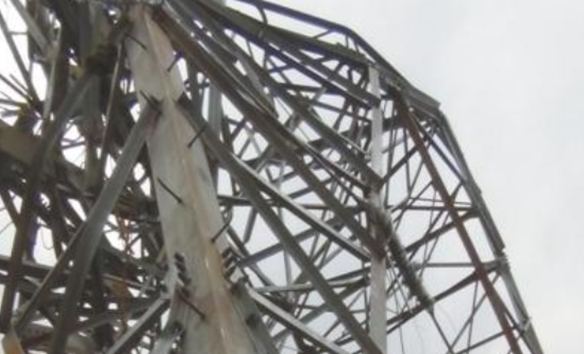
Although bolts are small, they are the “invisible guardians” of power tower safety! Imagine this: an entire towering power transmission tower is held together by countless bolts. If even one bolt becomes loose or falls out, it could trigger a chain reaction that jeopardizes the stability of the entire tower. Reviews of accidents in the power industry show that many tower collapses begin with problems involving these unassuming bolts.
Steel towers in the wild are constantly exposed to wind, rain, and extreme temperature fluctuations throughout the year. Combined with vibrations from nearby construction, it is not uncommon for bolts to strip, loosen, or even fall out. While the loss of a single bolt may seem insignificant, it causes the load to shift continuously to the surrounding bolts, leading to a sudden increase in load on adjacent bolts, which in turn causes them to loosen and fall out one after another, rapidly spreading the hazard. As the number of missing bolts increases, gaps and deformations appear at the steel frame joints. During high-wind conditions, the tower sways more violently, making it highly prone to tilting or even collapsing, which can cause power line breaks and circuit trips, compromising the safety of the power grid.
Manually climbing towers to inspect bolts is not only time-consuming and labor-intensive, but also involves extreme risks associated with working at heights. This is especially true for towers in remote mountainous areas, where it is even more difficult to conduct regular, thorough inspections. Only by monitoring the condition of bolts in real time can loosening or missing bolts be detected promptly, thereby fundamentally strengthening the safety defenses of the towers.
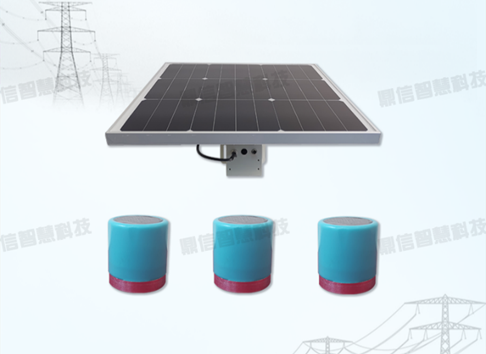
Dingxin Smart Technology’s DX-WPS100-LS Smart Bolt Online Monitoring Device for power transmission lines was designed specifically to address this challenge. At its core is a preload sensor specifically designed for bolt axial force monitoring—by attaching strain gauges to the bolt’s surface, the bolt itself becomes a sensor, while still functioning as a standard washer. Installation is as simple as tightening a slightly thicker screw—surprisingly straightforward. The sensors can operate independently or be interconnected to form a network, continuously monitoring load changes in all surrounding bolts from a single connection point and transmitting every slight stress fluctuation in real time.
Regarding data collection, the device supports both automatic and controlled modes, allowing users to flexibly set the collection interval based on parameter changes—as frequently as every 5 minutes, with a default interval of 30 minutes. It also collects the communication signal strength at its location to ensure that the data channel itself remains under monitoring. Data is uploaded to the cloud in real time for remote viewing and analysis by operations and maintenance personnel. Automatic alerts are triggered immediately upon exceeding thresholds, allowing early detection of signs of bolt loosening and eliminating potential hazards before they escalate.
In terms of data storage and security, the device can store at least 90 consecutive days of monitoring data, which will not be lost even if communication with the master station is interrupted and data cannot be uploaded. Power outages, voltage fluctuations, and voltage sags cannot erase the recorded dynamic data; no manual deletion or modification is permitted, and external access cannot alter even a single bit of data—with layers of protection in place, from hardware to logic.
In terms of alarm mechanisms, the device supports a wide range of alarm functions, including functional failures, communication interruptions, data out-of-range conditions, and self-test anomalies. Thresholds are configurable, alarm types are categorized, information is transmitted remotely in real time, and policies can be flexibly adjusted. Whether a bolt has actually come loose or the sensor is malfunctioning, a quick glance at the alarm makes it crystal clear, enabling precise and efficient maintenance responses.
In terms of power supply reliability, the unit comes equipped with a built-in energy harvesting module, a battery, and an independent charge/discharge controller with a nominal voltage of DC +12V. It features automatic float charging, overvoltage/undervoltage/overcurrent protection, and temperature compensation. Even without any sunlight or external power supply, the battery can last for at least 15 days, ensuring that the steel towers in remote mountainous forests remain securely in place.