What kinds of problems can occur with the hardware clamps on a power line?
When power outages occur due to circuit breakers tripping on many power lines, the root cause is never the conspicuous, large components like transmission towers or main lines, but rather the line clamps and connecting hardware that are often overlooked. These components securely hold the conductors in place, bear the load on the lines, and conduct electricity. Hidden throughout the towers, they are the unassuming yet indispensable “cogs” of the power grid.
Due to prolonged exposure to the elements—including sunlight, rain, wind, snow, and lightning strikes—hardware and line clamps are most prone to oxidation and rust. Surface corrosion gradually erodes the internal structure, causing a significant decline in the components’ strength. At the same time, the long-term vibration caused by wind sway can cause the screws and latches on line clamps to gradually loosen and shift, preventing them from securely holding the conductors in place. This makes it highly likely for conductors to slip, become loose, or hang loosely.
In addition, some older line clamps may exhibit fatigue cracks, deformation, or damage, and there are lingering issues such as improper installation and inadequate fastening resulting from past construction work. These hidden hazards are difficult to detect under normal conditions, but during severe weather—such as strong winds or heavy rain—they can lead to overheating, arcing, or broken wires, directly causing circuit breakers to trip and power outages, which significantly impact the stable operation of the distribution network.
To address these hidden thermal defects, we’d like to introduce Dingxin Smart Technology’s Smart Dual-Spectral Infrared Temperature Measurement Video Monitoring Device DX-WPS100-SP2, which uses a dual-vision solution combining dual-spectral infrared and visible light to accurately pinpoint high-temperature hazards in power lines.
The system consists of a main control unit, a communication module, a power supply module, a dual-camera PTZ unit, and a wireless transmission component. It utilizes a combination of solar power and lithium-ion batteries for long-lasting power supply and can use various transmission links—including 4G, 5G, Wi-Fi, and OPGW fiber optics—to synchronize on-site video footage and temperature data in real time to the monitoring backend, enabling comprehensive, routine monitoring of every detail of the tower structure, substation equipment, hardware fittings, insulators, conductors, and line corridors.
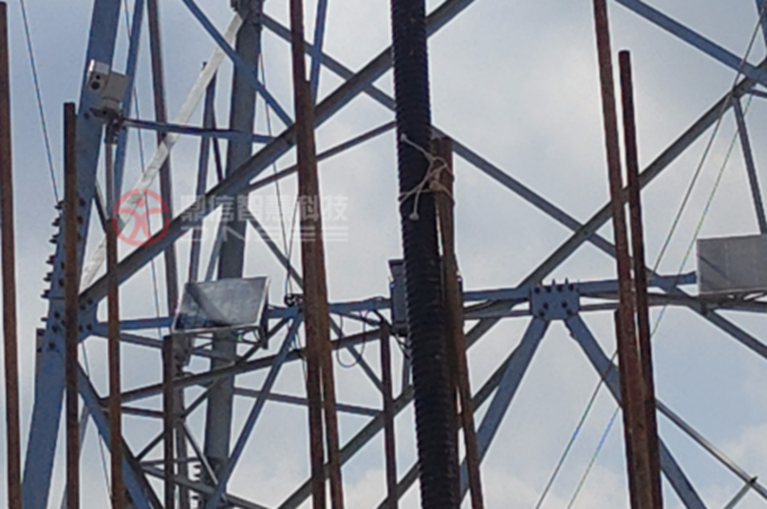
The core advantage of the intelligent dual-spectrum infrared temperature measurement video surveillance system for the power industry is its ability to detect temperature-related hazards invisible to the naked eye: dual-spectrum infrared technology can accurately measure temperatures at power distribution points such as line clamps, pole-mounted switches, and fuses, and immediately send alerts when thermal anomalies are detected; thermal imaging can be overlaid and fused with visible-light images, making the locations of potential hazards intuitive and clear; the system can also automatically organize inspection records, allowing users to view them at any time and export infrared inspection reports with a single click.
The pan-tilt unit features an ultra-wide adjustment range of 360° horizontally and ±90° vertically. Combined with 40x optical zoom, it can magnify close-up views to inspect minute deformations in hardware components and survey the entire line corridor from a distance. The device is equipped with AI algorithms specifically designed for power grid applications, enabling it to automatically capture and identify targets such as foreign objects and damage, and independently perform circuit patrol inspections. It also features fog penetration, intelligent exposure, and AI autofocus capabilities, combined with night vision, ensuring clear and stable imagery day and night.
The system offers a high degree of customization for operations and maintenance; staff can freely configure inspection routes, schedules, and operating hours. The device features multiple operating modes, including power-saving sleep mode, scheduled image capture, and 24/7 continuous operation. Operational data—such as voltage and communication signals—is collected at intervals as short as one minute.
From the monitoring center, all parameters—including pan/tilt control, lens zoom, and image quality—can be remotely adjusted. The device complies with China Southern Power Grid’s communication standards and can connect directly to the power grid’s operations and maintenance platform via the internal network APN. The smart dual-spectrum infrared temperature-measuring video surveillance device for the power industry boasts exceptional battery life; in complete darkness and without an external power source, the battery can sustain stable operation for more than half a month. When equipped with the optional voice alarm module, it can issue on-site voice warnings in the event of an emergency. Access permissions can be managed remotely, enabling round-the-clock intelligent monitoring to nip potential line faults caused by hardware fittings and line clamps in the bud.